

 Slides & Mechanisms
Push-to-Open Latches: Types, Selection, Installation
A push-to-open latch opens a handleless door with a light press; it comes as magnetic, butterfly, concealed, adhesive, and large 2-hole and 4-hole types, and the choice depends on door size and how it is fixed. This article explains how the mechanism works, how the types differ, when the large model is needed, which hinge it works with, and where and with what gap it is fitted. Push-to-open slides for drawers and the common faults, with their causes and fixes, are covered separately.
What a push-to-open latch is and how it works
A push-to-open latch (bas-aç, basaç, or 'tiq-tiq' in the local trade) is a small sprung pusher for opening doors without handles. Inside the body there is a spring, a plunger and a catch. When the door is closed, the plunger is pressed in and held by the catch. A light press on the door releases the catch, the spring drives the plunger forward and the door moves a few centimetres open; you open it the rest of the way by hand. To close, you press the door fully home again: the plunger goes in and the catch engages.
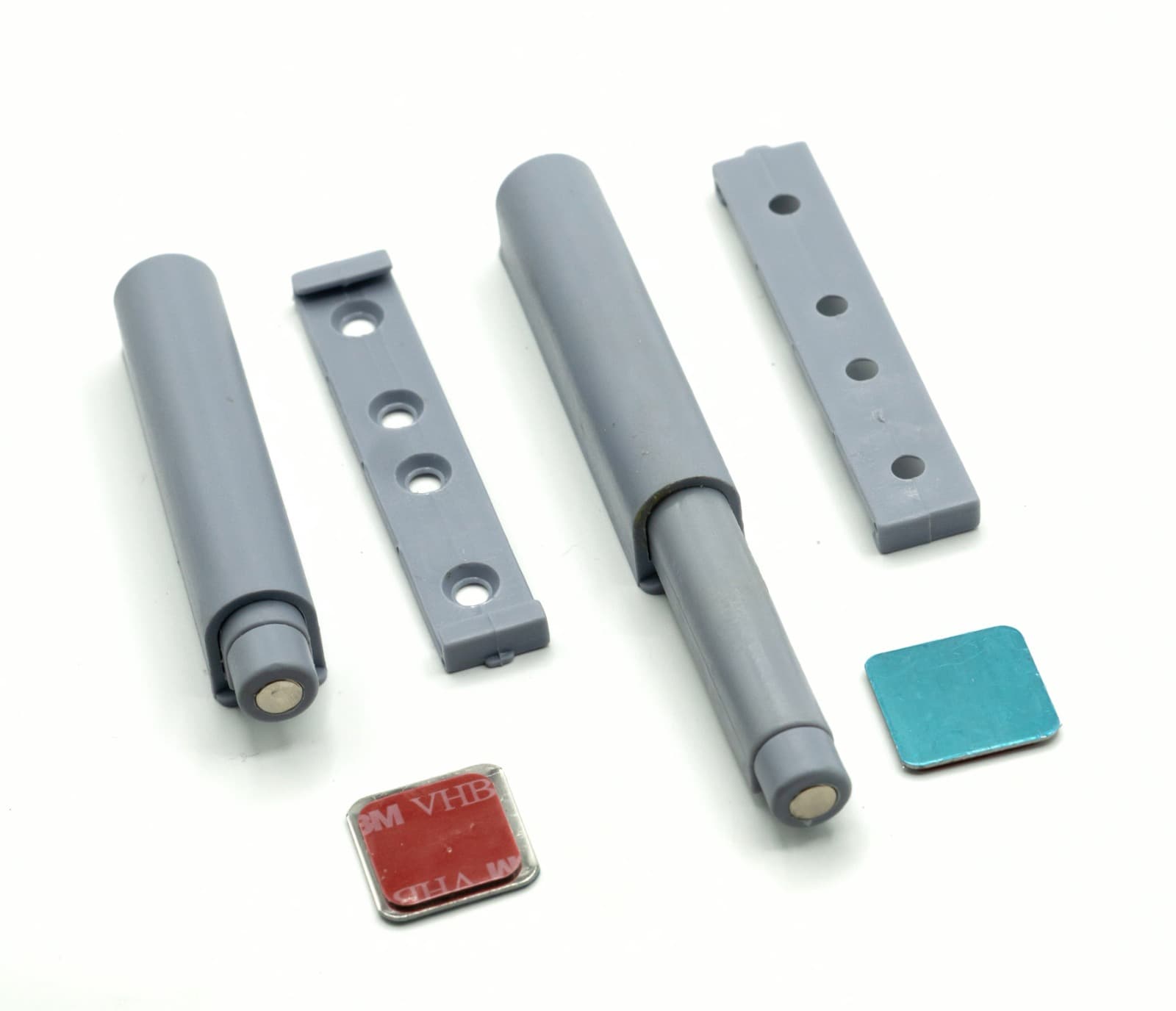
On models with a magnet at the tip of the plunger, a small metal plate is fixed to the inside face of the door: the magnet grips it and holds the door shut. In the catalogue this model is the magnetic push latch. Do not be misled by the word 'amortizator' (damper) in its name: it is not a part that slows the door, nor a gas strut, but a pusher.
Types: magnetic, butterfly, concealed, adhesive, metal
All the types work on the same principle; they differ mainly in how the body is fixed to the carcass. The magnetic model usually comes with a surface-mounted body screwed inside the cabinet, to a side panel or a shelf; check the fixing method on the product itself. The butterfly push latch has a plastic body and takes its name from its winged base: the wings give a wide seat for fixing.
The concealed push latch is set into a hole drilled in the edge of the panel, with only the tip left outside. Take the hole size from the mechanism itself. The adhesive snap-in push latch is fitted without drilling or screws: its base is stuck on with double-sided tape, and the body clips onto the base and can be taken off when needed. Local fitters also call it the 'screwless tiq-tiq'. The metal-bodied push latch is chosen for doors that are opened often: its body is metal, not plastic.
The choice depends on the space in the carcass: a surface-mounted model where there is room for screws, the concealed one where nothing may show from outside, the adhesive one where you do not want to drill the board.
Large 2-hole and 4-hole latches: for heavy and tall doors
A small latch opens an ordinary kitchen door easily, but on a tall wardrobe door or a large front it may not have the strength: when pressed, the door moves out only a little and cannot be caught with the fingers. For that there are large-bodied models. They have a stronger spring and a longer push stroke, so the door moves further out.
The large 2-hole push latch is fixed to the carcass with two screws, the large 4-hole push latch with four, on a wide base. Four points stop the body turning and working loose over time, so on heavy and frequently opened doors the four-hole model stays put more reliably.
On a tall door with a latch only at the top, the bottom corner may stay against the carcass. In that case two mechanisms are fitted, one at the top and one at the bottom. The door then has to be pressed in the middle so that both operate together.
Which hinge it works with
A push latch works against the hinge: the latch pushes the door out, while the hinge pulls it towards the closed position. That makes the choice of hinge important. A soft-close hinge does not work with a push latch. Its hydraulic damper brakes the last part of the travel: on closing, the door struggles to reach the latching point and the catch may not engage, and on opening the hinge resists the latch so the door does not move out far enough.
For push-to-open choose a plain hinge without a damper. The hinge type (full overlay, half overlay, inset) does not depend on this and is set by how the door sits on the carcass. The difference between the two hinges is covered in detail in soft-close vs standard hinges.
The spring of a plain hinge also pulls the door in. So on a tall door with many hinges a small latch may lack the strength; in that case move up to the large model or add a second mechanism.
Installation: position, gap and adjustment
Fit the mechanism on the opening side of the door, at the edge away from the hinges: close to a hinge the push has little leverage and the door moves out only slightly. It is usually fixed to the bottom or top of the carcass or to the edge of a shelf, near a corner of the door. It works better when it is close to where the hand normally presses.
A gap of a few millimetres has to remain between the closed door and the carcass. This is for the press stroke: if the door rests against the carcass, it has nowhere to go inwards and the catch will not release. On the magnetic model fix the metal plate to the inside face of the door at the point the tip touches. Check when buying whether the plate and screws are in the pack.
Fine adjustment is made at the tip: turn it to bring it out or in until the door stands level with the neighbouring fronts. Then test every door by opening and closing it several times.
Push-to-open slides for drawers
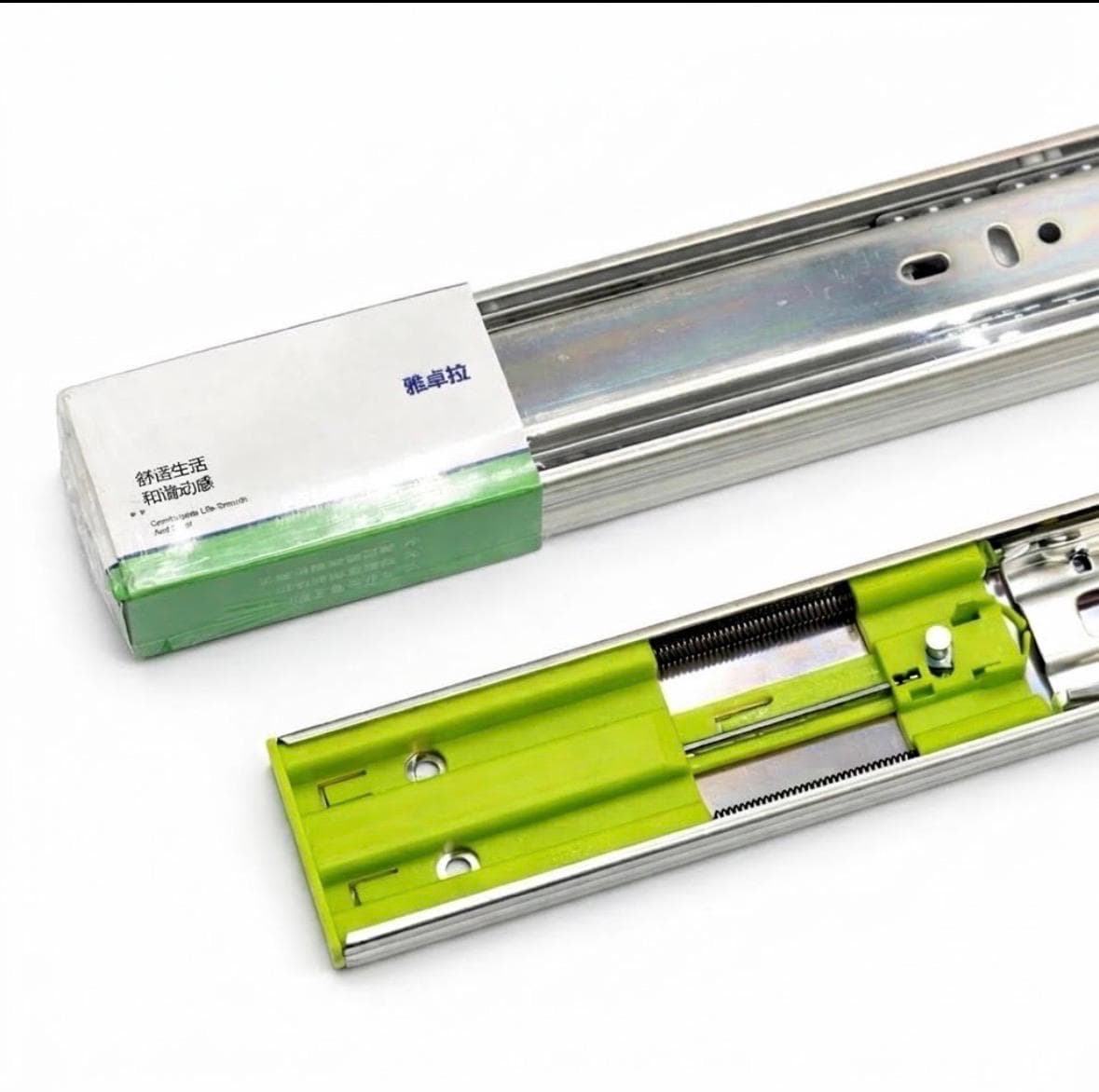
For a drawer the right solution is a push-to-open slide, where the mechanism is built into the slide. The push-to-open ball-bearing slide is a telescopic slide fixed to the side panel of the carcass: pressing the front releases the catch and a spring pushes the drawer out. It comes in lengths from 300 mm to 500 mm. The second option is the undermount push-to-open slide, which is fixed under the drawer and cannot be seen when it is open; it comes in the same lengths but requires the drawer box to be made to suit it.
In both cases the rule is the same: a gap of a few millimetres must be left between the front and the carcass for the press, and the drawer has to be pushed fully home for the catch to engage. A push-to-open slide has no damper, so the drawer will not close silently by itself. All the slide types are compared in drawer slide types.
Frequently asked questions
The door does not open when pressed. Most often the cause is a missing gap: the closed door rests against the carcass and has nowhere to go inwards. Turn the tip out a little so that the closed door stands a few millimetres off the carcass. The second cause is a soft-close hinge.
The door will not stay closed and comes back open. The catch is not engaging: either the door is not pressed fully home, or it meets the carcass before the plunger reaches the latching point. Turn the tip out, or fix the body a little further forward.
The door stands proud of the neighbouring fronts. The tip is set too far out: turn it in, but keep the press gap.
The adhesive model comes off. Clean dust and grease off the surface, stick the tape onto a smooth surface and press it down firmly. Test first with one piece whether it holds on unfaced board, or take a screw-fixed model. All the types are in the catalogue.
For an overview of every type, see the furniture hardware guide.
Want to place an order?
You can easily place your orders via WhatsApp.