


 Slides & Mechanisms
Drawer Slide Types: Ball-Bearing, Soft-Close, Undermount
Drawer slide types come down to four: plain ball-bearing, soft-close, push-to-open and undermount; the choice depends on the drawer's weight, whether it has a handle, and the budget. This article explains how each type works and where it fits, how 35 mm and 45 mm slides differ, and which slides mount on the side of the drawer and which underneath. It ends with the choice for kitchen, wardrobe and office drawers and the lengths held in stock.
Ray, rels, telescopic slide: names for the same thing
A slide is the metal mechanism that connects the drawer to the carcass and lets it travel in and out. Customers here call it siyirmə rayı, ray, rels, çəkməcə rayı, teleskop or telescopic slide, and направляющие in Russian. All of these mean the same part; what differs is the type, not the name.
A telescopic slide has steel profiles that run inside one another, with small steel balls rolling between them. Hence the other name, ball-bearing slide. One profile is fixed to the side panel of the carcass, the other to the side of the drawer.
Every drawer takes two slides, one left and one right. When ordering, check on the product page whether the item is counted as a pair (a set) or per piece, and work out the quantity from that. The types are explained below in order: plain, soft-close, push-to-open and undermount.
Plain ball-bearing slides: 35 mm versus 45 mm
A plain ball-bearing slide mounts between the side panel of the carcass and the side of the drawer. The number in the name is the height of the profile. The 35 mm plain slide is the narrow one, chosen for light, shallow drawers; it comes in lengths from 200 mm to 450 mm. The 45 mm plain slide is the wide one, a three-section telescopic slide that brings the drawer all the way out so that everything in it is visible. It is zinc plated and comes in lengths of 200–500 mm.
Neither has a damper. A drawer that is pushed runs in at speed and hits the carcass, so it has to be closed by hand, gently and all the way. On a full, heavy drawer that impact is noticeable and over time can loosen the fixing of the front. Plain slides belong in budget furniture, workshop and storeroom cabinets, and drawers that are rarely opened.
Soft-close slides: the drawer closes slowly by itself
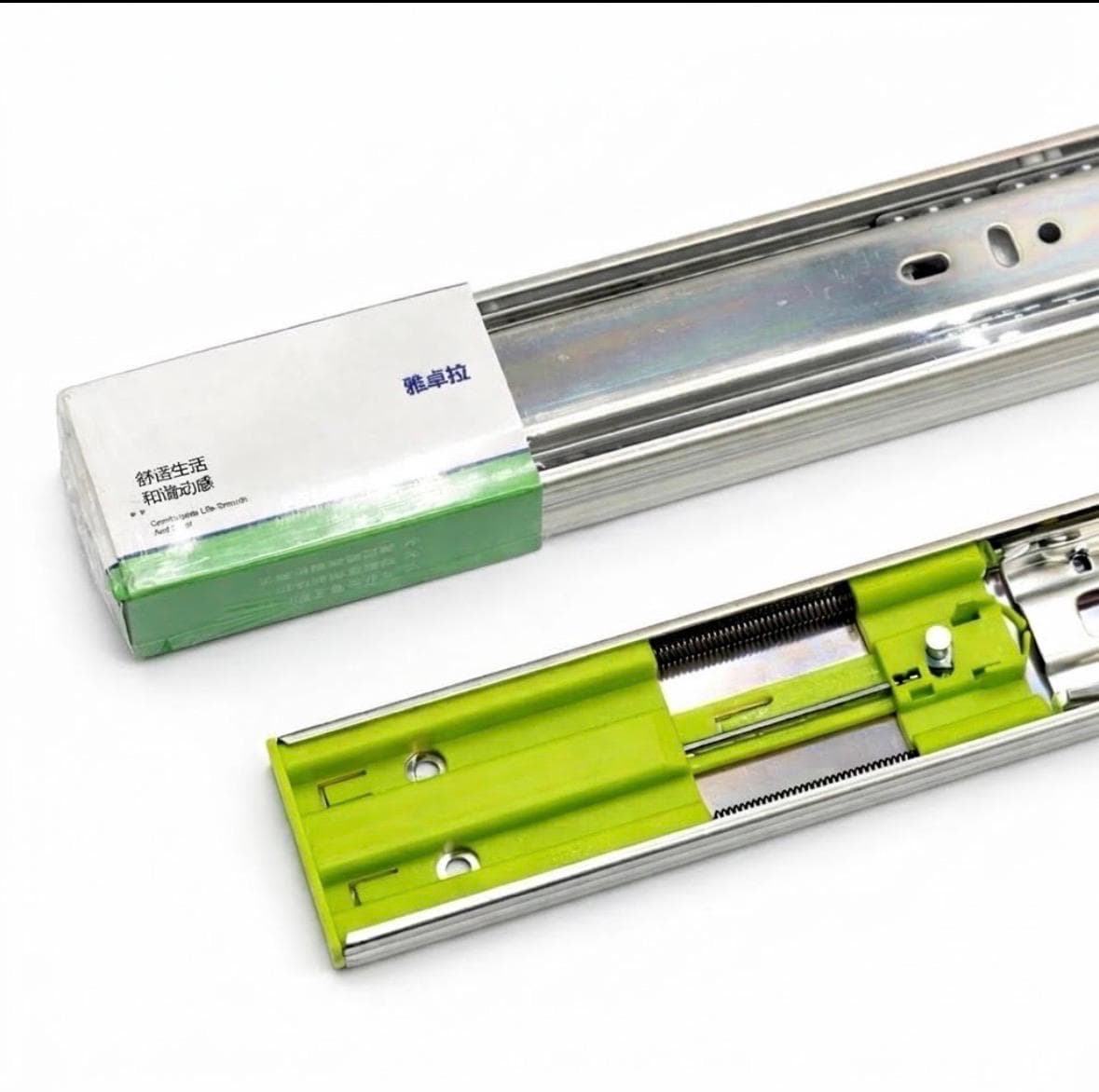
The soft-close ball-bearing slide is built like the plain one: it mounts on the side panel in the same way and runs on balls in the same way. The difference is the braking mechanism inside. Shortly before the drawer is closed, the mechanism catches it, takes the speed out and gently pulls it home by itself. Even a drawer that is pushed hard does not slam.
Local fitters call this slide yavaşladıcı, vakuumlu, tormozlu or samoraz ray. 'Vakuum' is simply the working name: there is no vacuum inside, the work is done by a hydraulic brake. In Russian it is направляющие с доводчиком.
Soft-close slides come in lengths from 200 mm to 600 mm in 50 mm steps, the widest range among the side-mounted slides. They are meant for a drawer with a handle: to open it you have to pull. For a handleless front you take a push-to-open slide; in this catalogue the two functions are not combined in one slide.
Push-to-open (bas-aç) slides: for handleless drawers
The push-to-open ball-bearing slide is for handleless fronts; locally it is called bas-aç ray. You press lightly on the drawer front, the catch releases and a spring inside pushes the drawer a little way out; you then pull it fully open by hand. To close, the drawer has to be pushed right home so that the catch engages again.
Because of the way it works, a gap of a few millimetres has to be left between the front and the carcass: when pressed, the front needs somewhere to travel inwards. If the front sits tight against the carcass, the mechanism will not work. The gap has to be the same on every drawer, otherwise the fronts will not line up.
A push-to-open slide has no damper: the drawer does not slow down by itself, you press it fully home by hand. Lengths run from 300 mm to 500 mm. Hinged doors use separate push latches; their types are covered in push-to-open latches.
Undermount slides: hidden under the drawer
An undermount slide is fixed under the drawer, not on its side. When the drawer is open no metal shows at the sides, only the drawer's own side panels. Two kinds are in stock: the undermount soft-close slide quietly closes the drawer by itself at the end of its travel, while the undermount push-to-open slide is for a handleless front and opens when pressed. The first comes in lengths of 250–550 mm, the second in 300–500 mm.
An undermount slide is not something you add to a finished drawer. The drawer box has to be made to suit it: room must be left under the bottom for the slide, and the width of the box and the position of the bottom must follow the slide's drawing. So the slide has to be chosen before the board is cut. Dimensions and a comparison with side-mounted slides are in undermount vs ball-bearing drawer slides.
Which slide for which drawer: kitchen, wardrobe, office
In a kitchen the cutlery drawer is opened many times a day, so a soft-close slide makes sense there: side-mounted, or undermount if the drawer box is made for it. Deep drawers for pots and pans are not hung on the narrow 35 mm slide; here you choose the wide 45 mm slide or a soft-close one. The catalogue gives no load rating, so for a very heavy drawer it is right to check the slide in your hands.
Handleless kitchens and living-room furniture take push-to-open slides, side-mounted or undermount. Clothes drawers in a wardrobe are light, and a plain 35 mm slide is enough for them; those who want the comfort take soft-close. In an office pedestal a drawer full of paper has to open all the way, so the fully opening 45 mm slide suits it. In budget furniture plain slides are fitted throughout.
What to check when buying slides
The first dimension is length. A slide is chosen by the internal depth of the carcass and cannot be longer than the depth of the drawer; the calculation is given step by step in how to choose drawer slide length. The second is type: plain or soft-close if there will be a handle, push-to-open if not; side-mounted or undermount.
Take the slide in your hands and run it out and in. The travel should be even and free of sticking, and the profiles should not wobble sideways. Look at the thickness of the metal: a thin profile bends under load. On a soft-close slide check that the mechanism pulls all the way home. Ask whether the price is for a pair or for one piece, and whether screws are included.
In stock, side-mounted slides run from 200 mm to 600 mm and undermount slides from 250 mm to 550 mm, in 50 mm steps. The lengths can be seen in the catalogue under the variants of each product.
For an overview of every type, see the furniture hardware guide.
Want to place an order?
You can easily place your orders via WhatsApp.