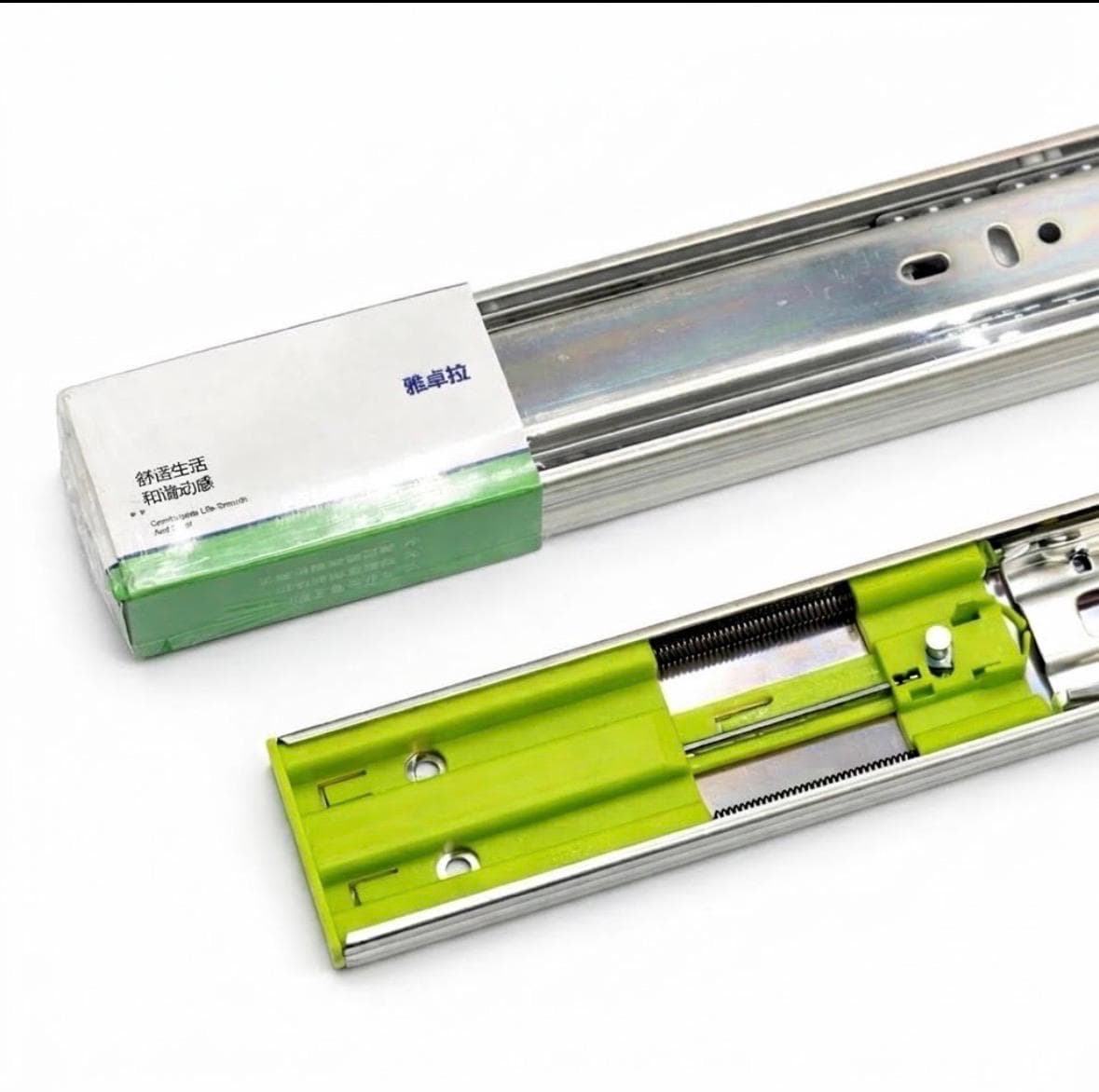


Furniture Hardware: Types and Buying Guide
Furniture hardware is the set of parts that make furniture open, slide, hold together and stand: hinges, drawer slides, push-to-open latches, handles, gas springs, legs, fasteners and edge banding. This guide explains briefly what each type does and what you choose it by, and ends with a list of what one kitchen needs. Every section links to a detailed article and to the products in the catalogue.
What furniture hardware is
Furniture hardware is every metal and plastic part that turns a carcass built from boards into working furniture. The hinge a door hangs on, the slide a drawer runs on, the gas spring that lifts a flap and holds it, the connector that pulls two boards together — all of it belongs to the same group. Buyers often call it furniture accessories, fitters and workshops call it hardware or fittings; in the shop the two names are used side by side.
The choice decides how long furniture lasts more than how it looks: of two kitchens built from the same board, one works quietly for years and the other has sagging doors after a year — the difference is usually in the hinges and slides. Below, the hardware is grouped by the job it does. Every group is on the categories page and every product is in the catalogue.
Hinges: what the door hangs on
A hinge is chosen by how the door sits on the cabinet. A full overlay hinge is for a door that covers the side panel completely, a half overlay hinge is used where two doors share one partition, and an inset hinge is for a door set inside the cabinet. The difference is shown on one wardrobe in the article on hinge types.
The second choice is how it closes: a soft-close hinge closes the door slowly and silently, a standard hinge closes with a spring and a click and costs noticeably less. Which door needs which is explained in the soft-close versus standard hinge comparison. An ordinary hinge does not work in corner cabinets: an angled corner door takes a 45° hinge, joining two folding doors takes a 135° hinge, and a wide opening takes a 165° hinge — see corner cabinet hinges.
A hinge sits in a 35 mm cup hole and is adjusted with its screws; the steps are in the installation and adjustment article. Catalogue: hinges.
Drawer slides: standard, soft-close, undermount and push-to-open
There are four kinds of drawer slide: standard ball-bearing, soft-close, push-to-open and undermount. The choice depends on the weight of the drawer, whether it has a handle, and the budget; where each one is used is covered in the article on slide types.
Length follows a simple rule: measure the inside depth of the cabinet and take the longest standard slide that is at least 10 mm shorter than it. How the width of the drawer box is worked out is in the article on slide sizes.
An undermount slide is fixed under the drawer, so no metal shows at the sides when the drawer is open, but it needs a drawer box built to suit it — more in what an undermount slide is. Catalogue: soft-close slides, undermount slides, push-to-open slides.
Handles and push-to-open latches
A front can be opened in three ways: with an ordinary handle, with a concealed profile handle, or with no handle at all — using a push-to-open latch. In one kitchen not every door opens comfortably the same way; where each option works well is compared in profile handle, push-to-open or ordinary handle.
The most common mistake when buying a handle is the size: 128, 160 and 192 mm are not the overall length of the handle but the distance between the centres of its two fixing holes. That is the distance to measure when replacing an old handle — see furniture handle sizes.
A push-to-open latch opens a handleless door with a light press; it comes in magnetic, butterfly, concealed and adhesive versions. How they differ and which hinge they work with is in the push-to-open latch article. Catalogue: handles, push-to-open.
Gas springs (lift supports)
Doors that open upwards or downwards are held by a gas spring, also called a lift support or gas strut. It is chosen by force: the heavier and taller the door, the more newtons it needs. For doors there are 60 to 250 N in stock — how to choose: how many newtons you need.
In a storage bed the gas spring is matched to the weight of the mattress and the lifting frame, and here the force runs from 450 to 1500 N. One that is too weak makes the base heavy to lift, and one that is too strong will not let it stay closed — see gas springs for bed bases and gas springs for beds and sofas. Catalogue: gas springs.
Kitchen fittings: dish rack, sink, pull-out basket
Besides hardware, a kitchen needs ready-made units that go inside the cabinets. A dish drying rack is bought by the width of the wall cabinet it goes into: 50, 60, 70, 80, 90 or 100 cm; the size is the cabinet module, not the width of the wire rack itself — dish rack sizes.
A sink is chosen in three steps: the size of the cabinet it sits in, the number of bowls, and the finish — matt, polished or black; more in how to choose a stainless steel sink. Pull-out baskets and bottle racks, which turn a narrow base cabinet into a basket on slides, are sold for 150–300 mm modules — pull-out basket and bottle rack.
Catalogue: dish racks, kitchen sinks, waste bin.
Wardrobe fittings: rail, hanger, shelf support
The inside of a wardrobe is built from a few simple parts: a hanging rail with its brackets, a pull-out hanger for a shallow cabinet, shelf supports, and rollers for sliding doors. Which of them you need is decided by the depth of the cabinet and what you will keep in it. How to divide a wardrobe between hanging and folded clothes is shown in wardrobe interior fittings.
Catalogue: rails and brackets, hangers, shelf supports.
Legs, castors and table mechanisms
A furniture leg lifts the carcass off the floor and levels it: an adjustable plastic leg in the kitchen, a chrome leg where it is on show, and castors on furniture that is moved often; felt pads protect a wooden floor. Where each one belongs is in furniture legs and castors.
An extending table mechanism comes in four kinds: synchronised slides, a centre-leaf mechanism, a folding bracket and a transformer. The choice depends on the size of the room and how often the table is opened — extending table mechanisms. Catalogue: legs and castors, table slides.
Fasteners, edge banding and adhesive
Fasteners hold the carcass together. A minifix pulls two boards together at a right angle out of sight and lets the furniture be taken apart again — what a minifix is. A screw size is two numbers: in 3.5×16 the first is the diameter and the second the length; a short screw fixes hardware, a long one fixes boards — furniture screw sizes.
PVC edge banding covers the cut edge of a board: 0.4 mm for edges that are out of sight and take no knocks, 0.8 mm for edges on show, such as fronts — 0.4 mm or 0.8 mm. On the machine the banding is held by EVA hot-melt adhesive; there are separate kinds for straight and for curved edges — edge banding adhesive.
Catalogue: minifix, screws, corner brackets, PVC edge banding, adhesives.
Upholstery materials and LED lighting
Workshops that build sofas and fitters who re-cover old ones need more than fabric: a seat base (zigzag spring or elastic webbing), filling (fibre), staples and a sofa mechanism. What each material does is in upholstery materials. Catalogue: sofa mechanisms, staples.
Furniture lighting is a set built from parts that match each other: an LED strip, a power supply sized to it, and a sensor or remote. Do not connect anything before reading what is printed on the strip and on the power supply — choosing an LED strip, power supply and sensor. Catalogue: electrical and lighting.
What hardware one kitchen needs
The most reliable way to draw up the list is to go through the cabinets one by one:
For every door — two hinges or more, depending on its height; corner hinges for corner doors.
For every drawer — a pair of slides, with the length set by the depth of the cabinet.
For every lift-up door — a gas spring matched to its weight.
For every door and drawer — a handle, a profile handle or a push-to-open latch.
For base cabinets — adjustable legs; for the wall cabinet — a dish rack; for the sink cabinet — a sink.
For the carcass — minifix connectors, screws and edge banding.
How the quantity of each is worked out is shown with an example in the kitchen hardware checklist.
How to order furniture hardware
GreenFurn.az sells furniture hardware wholesale and retail. The price and the available sizes are shown on each product page: choose the size, add the product to the basket and confirm the order on WhatsApp. If you are not sure which size or type fits, send the cabinet dimensions and ask — see all products.
Want to place an order?
You can easily place your orders via WhatsApp.