

 Slides & Mechanisms
Bed Lift Gas Springs and Mechanisms: How to Choose
A bed lift gas spring is chosen by the weight of the mattress and the lifting frame; we stock forces from 450 to 1500 N. Too weak and the base is heavy to raise, too strong and it will not stay closed. This article explains how a storage bed lifts, what the numbers on the cylinder mean, when and how to replace an old gas spring, and which safety rules to follow before you start.
How a storage bed lifts: mechanism and gas spring
In a storage bed the base under the mattress swings up to open the storage space below. Two separate parts make this happen. The first is the steel lift mechanism: hinged arms on the left and right, one end bolted to the fixed bed frame and the other to the mattress base. The mechanism sets the path the base follows as it rises, but it does not carry the weight.
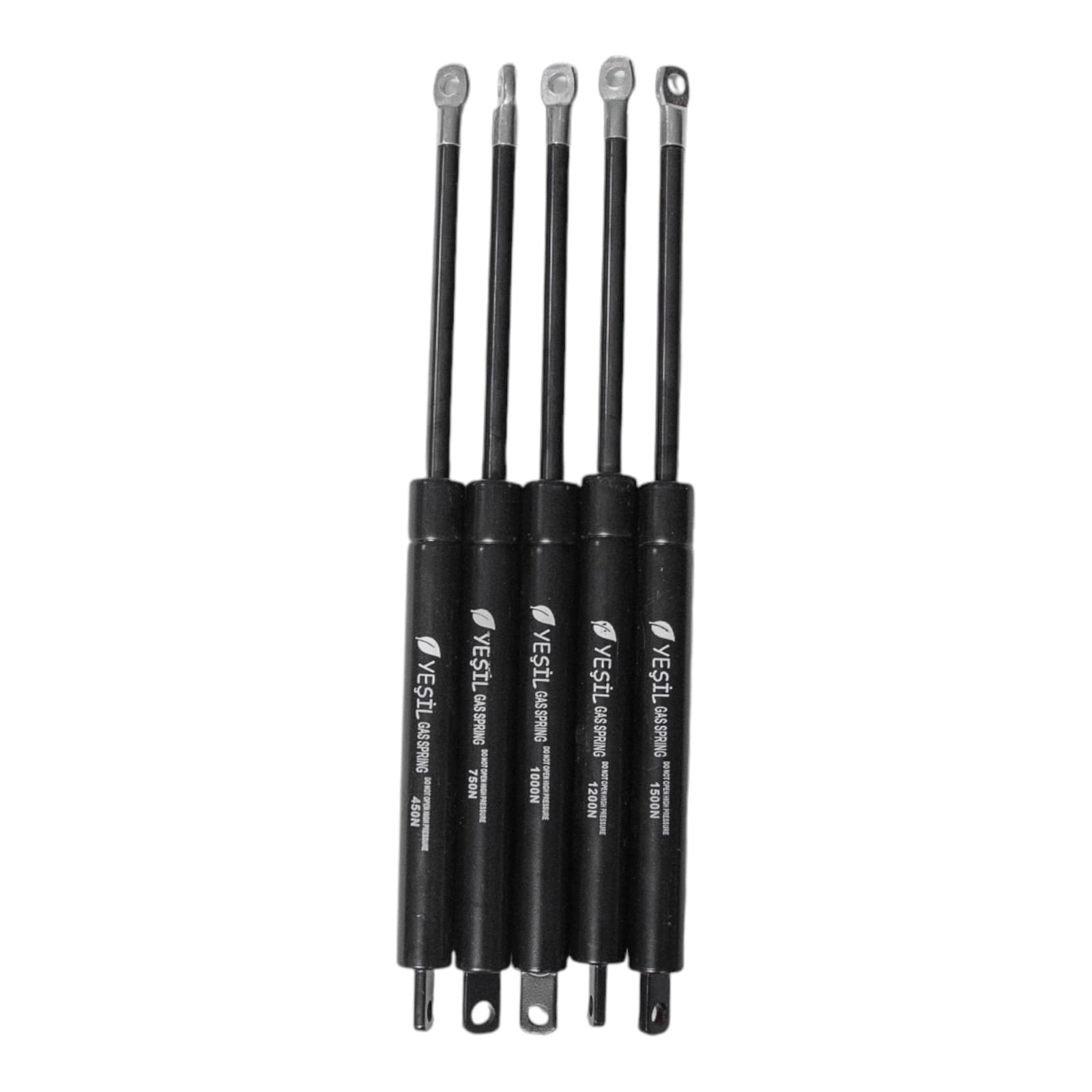
The second part is the gas spring. Customers often call it a shock absorber or even a “pump”, but it is a gas spring: a sealed cylinder of compressed gas with a rod that is pushed out of it. One is fitted on each side of the mechanism, and they take most of the weight.
On the site these are two separate products: the bed lift mechanism for anyone building a new bed, and the bed gas spring sold on its own to replace a weakened one. When ordering the mechanism, check whether gas springs are included in the set.
From 450 to 1500 newtons: what the numbers mean
The force of a gas spring is measured in newtons (N) and printed on the cylinder, for example 1000N. It is the force with which the rod is pushed out of the cylinder. For comparison, a 1 kg load weighs about 10 N. That does not mean a 1000 N spring lifts 100 kg: the spring acts on the base through the lever of the mechanism, not directly, so the real lifting force depends on the geometry of the arms.
We stock the bed gas spring in 450, 750, 1000, 1200 and 1500 N, and the lift mechanism in 450, 750, 1000 and 1200 N. On the product page these values appear in the size selector; the number you pick there is force in newtons, not length. People searching for a “1000N gas spring” or a “1200N strut” mean exactly these variants.
How many newtons you need: mattress and frame weight
Start from the weight being lifted: the mattress plus the base that rises with it (slatted frame, upholstery and top panel, if there is one). A thick sprung mattress and a wide double bed need more force; a single bed with a light mattress needs less. Gas springs work in pairs, so the load is shared between two.
For rough orientation, one manufacturer's chart lists 500 N for 25–30 kg of lifted weight, 750 N for 35–40 kg, 1200 N for 55–60 kg and 1500 N for 65–70 kg. These figures are not universal: another mechanism has arms of a different length, and the same weight calls for a different force.
That is why the old gas spring is the most reliable guide. When replacing, read the marking on the cylinder and buy the same force. If you have changed to a heavier mattress, it is reasonable to look at the next force up.
Signs of a gas spring that is too strong or too weak
A weak gas spring is easy to recognise: the base takes real effort to lift, will not stay open and sinks by itself. That is not just inconvenient but dangerous, because the base can drop onto hands or a head.
A spring that is too strong causes the opposite problem. The base is hard to push down, it rises on its own when the mattress is taken off, and in the closed position the spring keeps the mechanism's fixing points under constant load. Over time the bolts work loose and the holes in a chipboard frame wear oversize.
The third case is wear. A gas spring slowly loses force over the years: a base that used to lift easily becomes heavy and no longer stays open. An oil trace on the rod means the seal has failed. A spring like this is not repaired but replaced, and both springs of the pair are changed together.
Replacing a gas spring, and safety
Before you start, take the mattress off and open the base fully: in this position the gas spring is at its least compressed. Prop the base with a solid support, such as a length of timber cut to suit, or have a second person hold it. Never put a hand or your head under a base that is not supported.
Change the springs one at a time. Undo the fixings at both ends of the first one, remove it, check that the length and end fittings of the new spring match the old one, and fit it the same way round as the old one sat. Only then move to the other side. Finally remove the prop and open and close the base several times, first without the mattress and then with it.
The cylinder is under high pressure. Never open, drill, cut or heat it; dispose of the old spring without taking it apart. Keep children out of the room while you work.
Bed corner brackets: reinforcing the frame
A lifting base loads the bed frame differently from an ordinary bed: the gas springs push on the side rails all the time, and every time the base opens the load goes into the corners. Once the corners work loose the frame goes out of square, the mechanism runs skewed and the bed starts to creak.
So the corners are tied with steel brackets. To join the side rails to the headboard and footboard, use the bed corner bracket PRO or the 70 mm connecting bracket; the latter is also used on table frames.
A screw driven straight into chipboard strips its hole when it is retightened. A more durable fixing is a bolt with a T-nut: drill a hole, hammer the nut in from the side opposite the bolt head, and its prongs bite into the material. Tightening the bolt only pulls the nut in harder, and if the joint loosens it can be nipped up again. The nuts are sold with M6 and M8 threads.
What to check when buying
Three things must match the old gas spring: force (N), overall length and the type of end fittings. Measure the length with the rod fully extended, from the centre of one fixing hole to the centre of the other. If length and end fitting are not given on the product page, ask before ordering; the simplest way is to bring the old spring, or a photo of its label, to the shop.
Always buy gas springs as a pair. With one new and one old, the base is pushed harder on one side, twists, and the mechanism soon fails.
Gas struts for kitchen wall cabinets come in a completely different force range and are not suitable for a bed; they are covered in how many newtons a cabinet gas strut needs. The other fixings for a bed are in the hardware catalogue.
For an overview of every type, see the furniture hardware guide.
Want to place an order?
You can easily place your orders via WhatsApp.