

 Handles, Legs & Lighting
Cabinet Handle Sizes: 128, 160, 192 mm Explained
Cabinet handle sizes — 128, 160, 192 mm — give the distance between the centres of the two fixing holes, not the overall length of the handle. The handle itself is always somewhat longer than the number. Below we explain how to take the size when replacing an old handle, which length suits the width of a door or drawer, where the holes are drilled and how many handles one kitchen needs. The examples use models from the catalogue.
128, 160, 192 mm: What the Number Means
The number in the handle's name or in the list of variants is the centre-to-centre distance: the measurement from the centre of one screw hole to the centre of the other. Cabinet handle sizes step by 32 mm: 96, 128, 160, 192, 224, 320 mm and so on. The reason is that furniture production drills holes on a 32 mm pitch, and handle makers follow the same series.
The handle itself is longer than the number, because the width of the feet and the ends that run past the feet are added. On a bridge handle the difference is usually one or two centimetres, while on a bar (rail) handle the ends project well beyond the feet. In the catalogue model 014, 021 and model 695 are sold in 128, 160 and 192 mm hole centres. To know whether a handle fits the width of a front, ask for the overall length separately or measure the handle in your hands.
How to Take the Size When Replacing an Old Handle
Remove the old handle and measure the distance between the centres of the two holes left in the front. If the centre is hard to judge by eye, measure from the left edge of one hole to the left edge of the other — the result is the same. The figure should match one of the sizes on the 32 mm series: 96, 128, 160, 192. If you get 127 or 129 mm, that is measuring error and the handle is a 128 mm one.
If you buy a handle with the same hole centres, it goes into the old holes and leaves no marks on the front. If you change the size, new holes have to be drilled and the old ones stay visible on the face; they can be filled with furniture wax, but on a plain front the spot still shows. At present the sizes in the catalogue start at 128 mm, so if the old furniture turns out to be 96 mm, be ready to drill new holes. Keep the old screw too and measure its length: the new handle may need a different one.
Handle Length by Door and Drawer Width
For a handle fitted horizontally, the proportion most often used is this: the handle is about one third of the width of the front. It is not a standard, just a proportion that looks balanced. A 400 mm drawer suits 128 mm hole centres, a 500–600 mm one suits 160 or 192 mm. On a door the handle is usually fitted vertically and width matters less: 128 or 160 mm is enough for an ordinary kitchen door. Small doors and narrow drawers take a knob.
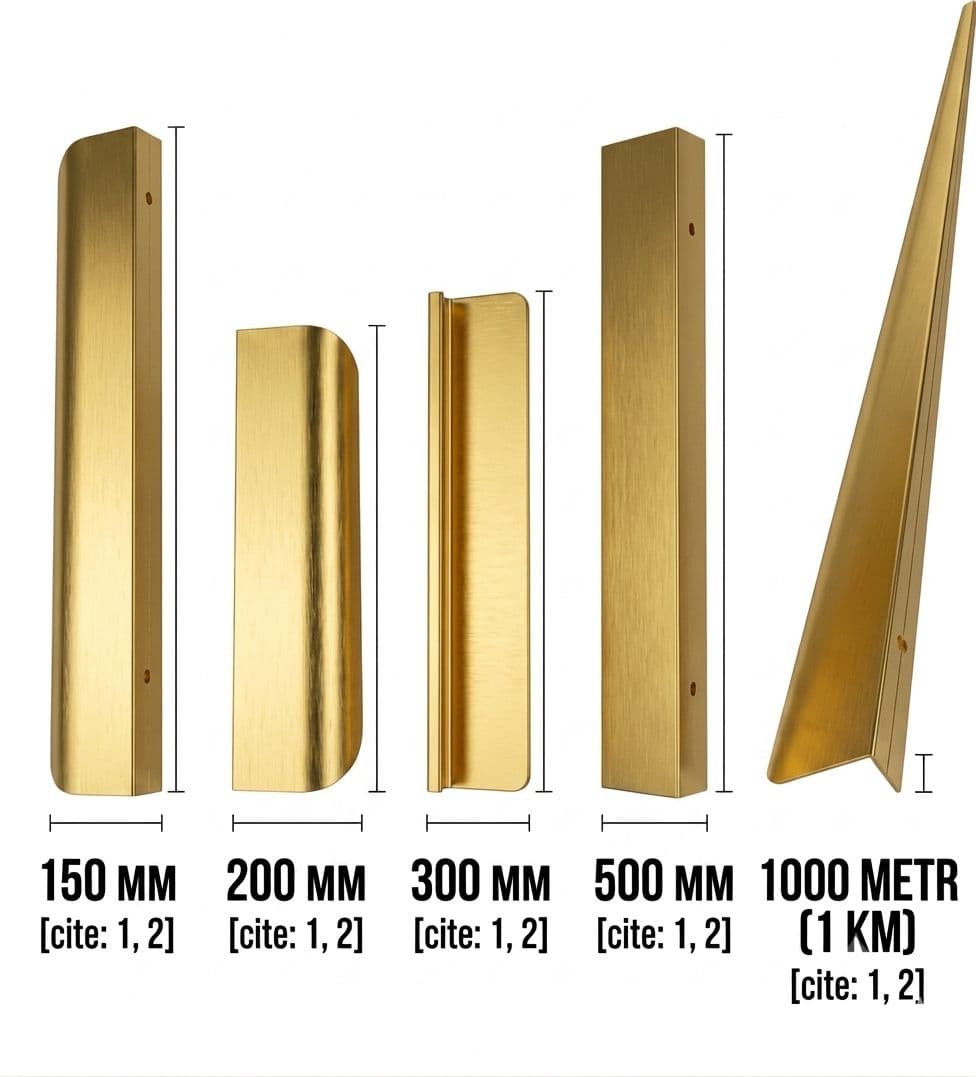
On drawers 900 mm wide and more, and on tall wardrobe doors, a long handle is more comfortable: you can grip it anywhere along its length. Model 9095 comes in 320, 600, 800 and 1000 mm as well as 160 and 192 mm. For the long sizes, confirm before ordering whether the number is the hole centres or the overall length, and at how many points the handle is fixed: the hole positions depend on it.
Handle Types: Bar, Bridge, Knob and Long Models
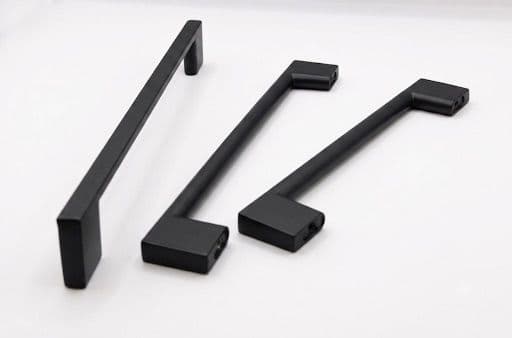
Shape affects both the look and the grip. A bar handle is a cylindrical rod standing on two feet; in the catalogue it comes in 128 mm hole centres. Its ends run past the feet, so the overall length is noticeably greater than the number, and in a narrow passage the ends can catch on clothing.
A bridge handle meets the front at its two ends and has nothing projecting sideways. The numbered models belong to this group: 014, model 021, 695, 7222 and model 9060, which comes only in 160 mm. The number identifies the shape of the model, not the size; one model is made in several hole centres.
A round knob is fixed with one screw, so it has no hole centres and the hole is hard to get wrong. Its drawback is that a heavy drawer is awkward to pull with two fingers. If you would rather see no handles on the fronts at all, read the comparison of profile handles, push-to-open and regular handles.
Choosing Colour and Finish
The catalogue lists the numbered models in black; model 7222 is described as black matt and comes in 128 and 160 mm. The bar handle is listed in black, silver and gold, the round knob in silver, black, white and gold. The material of every model is given simply as metal; if the exact alloy and coating matter to you, ask the seller.
There is no need to match the handle colour to the hinges and slides: they cannot be seen when the door is closed. What is on view is the tap, the sink, the hob and the extractor, and it makes more sense to choose the handle in the same tone as those. A black matt handle gives contrast on a light front and disappears on a dark one. Fingerprints and water drops show more on polished chrome; a matt surface hides them better, though a greasy hand leaves a mark on dark matt too. In a kitchen the handle is often gripped with a wet hand, so this is a matter of cleaning as well as taste.
Hole Positions and Fixing
On a door the handle is usually fitted vertically on the side opposite the hinges: near the top corner of the door on base units, near the bottom corner on wall units. Keep the distance from the edge the same on every door. On a drawer the handle is fitted horizontally and centred across the width; in height it sits in the middle or in the upper part. Keep to one rule for all drawers in a row.
For a whole kitchen, make a template: drill two holes at the required centres in a piece of board and fix a stop for the corner. Then you do not have to mark out every front separately and an error is not repeated. Drill from the face side and clamp a block of wood behind, so the laminate does not break out as the bit comes through.
The handle screw is usually M4, but check this on the product and ask whether screws are included. The length has to suit the thickness of the front: a screw meant for a 16–18 mm front is too short on a drawer where a separate front is fixed to the front wall of the box.
How Many Handles One Kitchen Needs
The count is simple: one handle per door and one per drawer front. Drawers wider than 900 mm sometimes get two short handles; the drawer then has to be pulled with both hands, which is why many people prefer one long handle. The dishwasher front, the doors of a built-in fridge and the front of a bottle pull-out are part of the count too.
Example: with six doors in the upper row, four doors in the lower row and one unit with three drawers, you need 6 + 4 + 3 = 13 handles. Add one or two spares: finding the same model in the same colour later can be difficult. If you take different hole centres for doors and drawers, count each size separately.
To count handles together with hinges, slides and the rest, see the kitchen hardware checklist. All models are listed with their sizes in the catalogue.
For an overview of every type, see the furniture hardware guide.
Want to place an order?
You can easily place your orders via WhatsApp.