

 Handles, Legs & Lighting
Profile Handle, Push-to-Open or Regular Handle?
A front can be opened three ways: a profile handle on the edge, a push-to-open latch or a regular handle; we compare look, comfort, cleaning and price. Not every door in a kitchen opens comfortably the same way, so we show separately where each option works well, where it gets in the way, how they are combined in one kitchen and how to choose the length of a profile handle. The examples use products from the catalogue.
Three Routes to a Handleless Look
"Handleless furniture" usually means a smooth front with no projecting parts. The first is the profile handle, also called a concealed or edge handle: a thin profile fixed to the edge of the front. From the front you see only a fine line along the edge, but it is still a handle and you grip it with your fingers.
The second is push-to-open. Here there really is nothing on the front: you press the door and a mechanism inside pushes it forward. In the strict sense, only this option is handleless.
The third is the regular handle fixed to the face. It does not give a smooth look, but it is comfortable to grip. The choice does not end with taste: each option needs different hardware behind the front — push-to-open needs other hinges and slides, and a profile handle needs space on the edge of the front. That is why the decision has to be made before the fronts are ordered.
What a Profile Handle Is and How It Is Fixed
A profile handle is a metal profile slipped over the top, bottom or side edge of the front. One leg of the profile sits on the edge and forms a lip for the fingers; the other part rests against the back face of the front. It is usually fixed with screws from the back, so no holes are left on the face. The screw must be shorter than the thickness of the front, or its tip will come through the face.
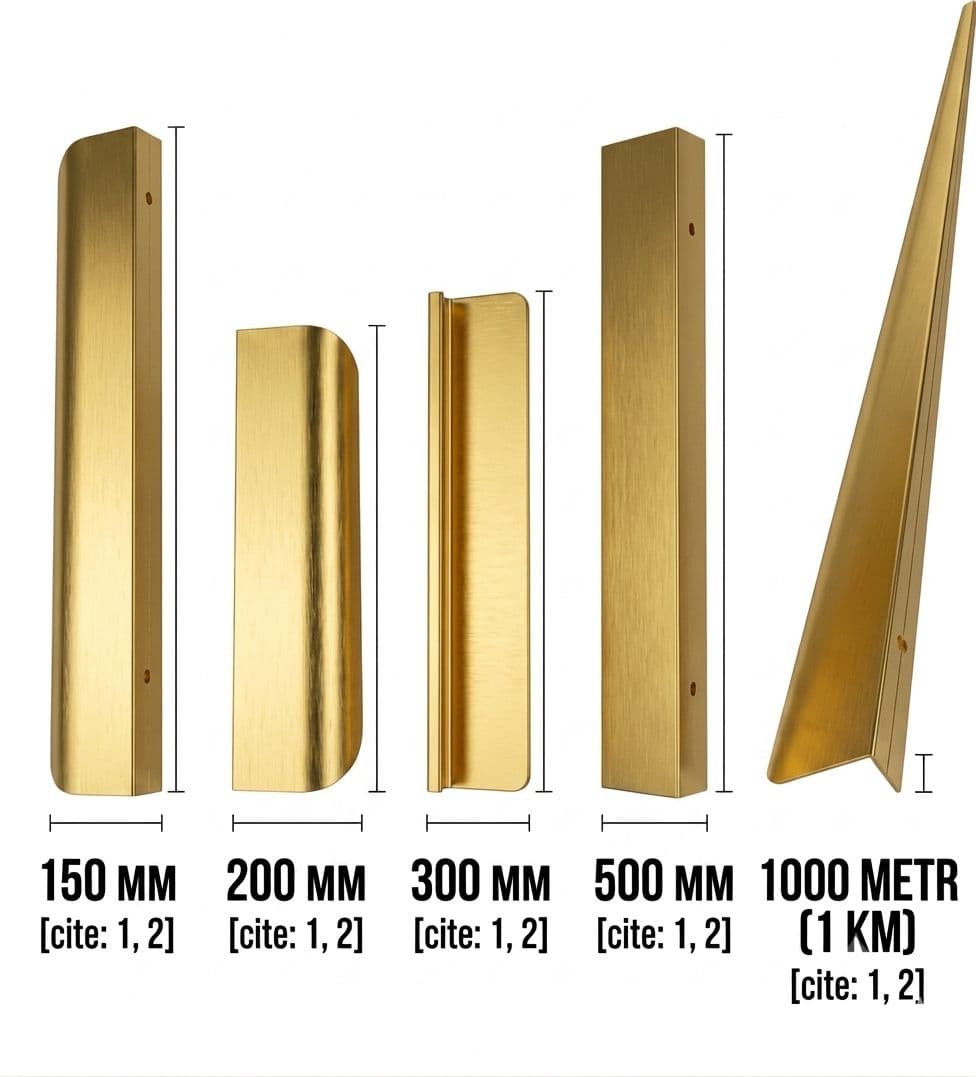
The catalogue has two models, both sold in 150, 200, 300, 500, 800 mm and 1 m lengths: a gold-coloured profile handle whose material is given as aluminium, and a black profile handle whose material is given as metal. Before buying, ask which front thickness the profile is made for — 16 or 18 mm: it has to sit tight on the edge.
Bear in mind that the profile stands a few millimetres proud of the edge of the front. Fitted on the top edge of a base unit, it needs a finger gap between the worktop and the front; fitted on the bottom edge of a wall unit, it needs a gap below the front.
Push-to-Open: Nothing Visible on the Face
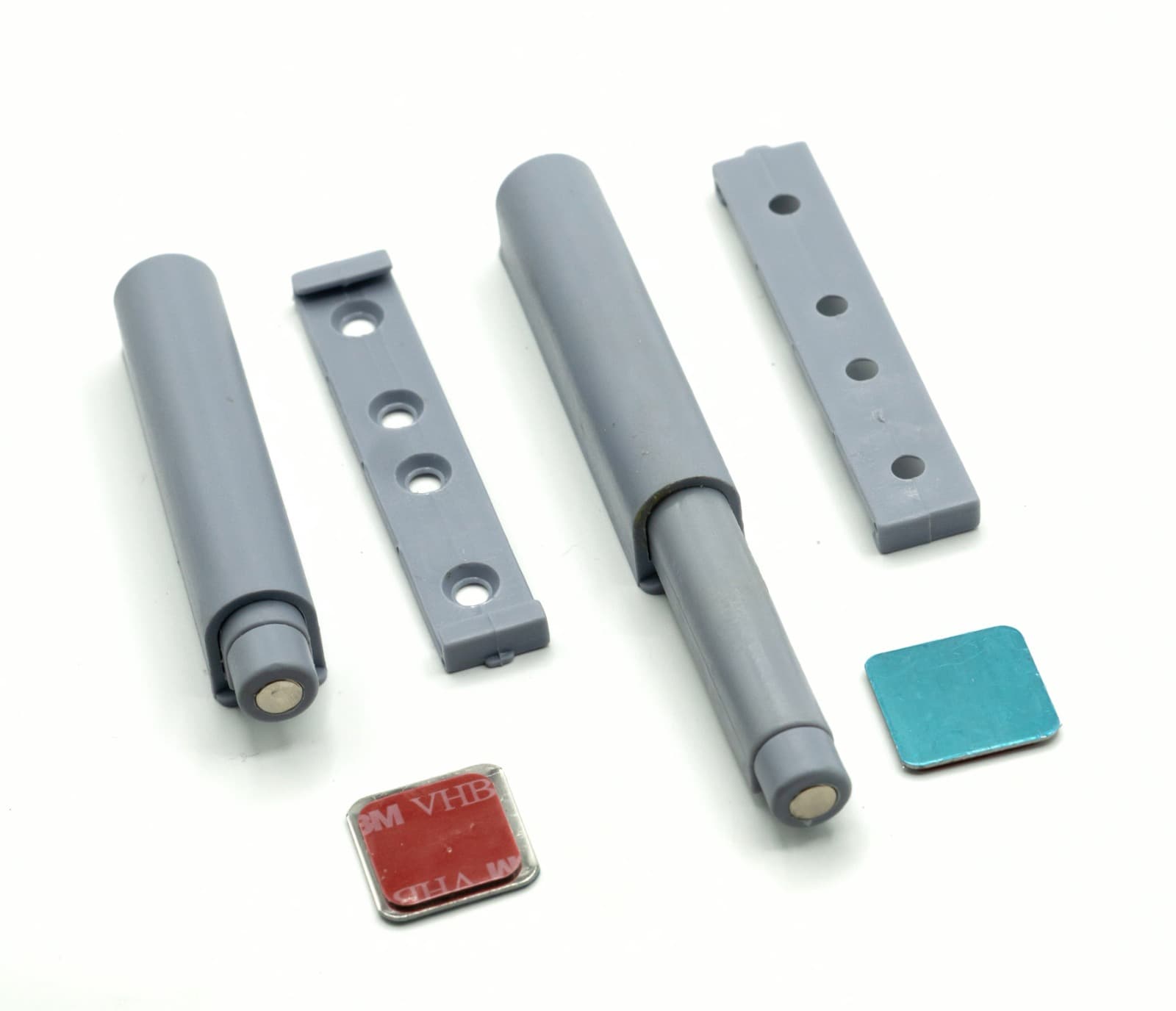
A push-to-open latch is a spring-loaded ejector that sits in the carcass behind the door. When you press the door it throws it forward a few centimetres, and you then take the edge and open it. On the magnetic push latch a magnet at the tip holds the closed door in place; the concealed push latch is seated in a hole drilled into the edge of the carcass panel and is hard to see even with the door open.
Its weak points are these. To be pressed, the door needs a gap of a few millimetres between it and the carcass, so the door does not sit tight. Push-to-open does not work with soft-close hinges: it needs plain hinges without a damper, which means the door will not close silently. Because the same spot is pressed every time, fingerprints build up on glossy and dark fronts. Leaning on the door or touching it with a knee can open it by accident.
On a drawer no separate latch is fitted: the slide itself does the job, for example an under-mount push-to-open slide. The types of mechanism and how to fit them are covered in detail in the guide to push-to-open latches.
Regular Handle: The Inexpensive, Comfortable Choice
A handle fixed to the face can be gripped with a wet, greasy or full hand: hooking one finger through and pulling is enough. A handle places no conditions on the hardware behind the front: soft-close hinges and slides work freely with it, and the door closes tight and quietly.
The cost side is simple too. One handle is fixed to one front and needs no special slide for a drawer. When it wears or tastes change, you buy another model with the same hole centres and fit it in the same place. The black matt model 7222 in the catalogue comes in 128 and 160 mm hole centres; how to read that number is explained in the guide to cabinet handle sizes.
Its drawbacks are about appearance: the handle stands on the front and the surface is not smooth. In a narrow kitchen a projecting handle catches on clothing and pockets, and in corner units it can stop the neighbouring door from opening fully.
Comparison: Look, Comfort, Cleaning, Price
On looks, push-to-open comes first: there is nothing on the face. A profile handle gives a fine line along the edge, while a regular handle becomes part of the front. On comfort the order is reversed: a regular handle works with any hand, a profile handle has to be gripped with the fingertips, and push-to-open takes two movements — press and open.
In cleaning, the difference is where the dirt collects. With a regular handle you have to wipe round the base of the feet. Crumbs and dust settle in the channel of a profile handle fitted on a top edge. Push-to-open has no parts, but you wipe fingerprints off the front itself. On price, for a door a regular handle and a push latch are close to each other; drawers make the difference, because there push-to-open means a special slide. With a profile handle the price rises with the length.
The conclusion: if looks matter above all and you can do without silent closing — push-to-open; if you want a smooth line and a normal grip — a profile handle; if the kitchen is used heavily and the budget is limited — a regular handle.
Which Option Suits Which Place in the Kitchen
Combining two or even three methods in one kitchen is normal. On base drawers a profile handle on the top edge works well: the hand naturally comes from above and the drawer can be gripped anywhere along its width. On wall units the profile goes on the bottom edge, or push-to-open is used — nobody leans on the door there and the risk of accidental opening is low.
Do not rely on push-to-open for heavy and tightly sealing doors. The door of a built-in fridge is held by a rubber seal and the force of the latch may not be enough to open it; a dishwasher door is also pulled with some force. A sturdy handle that takes the whole hand is the advice for such places — for example the long model 9095, which comes in sizes up to 1000 mm. The same logic holds for the waste bin cabinet and for drawers that are opened often: with a dirty hand it is cleaner to take a handle than to press the front. On tall larder doors the profile is fitted on the side edge.
How to Choose the Length of a Profile Handle
There are two approaches. The first is a short piece: a 150 or 200 mm profile is fitted in the middle of the edge and works like a regular handle, only it sits on the edge rather than on the face. This suits narrow doors and anyone who wants the same size on every front.
The second is a profile running almost the full width of the front. Here choose the length from the available sizes so that the profile is shorter than the front and an equal margin is left at both ends. A 400 mm front takes a 300 mm profile, leaving 50 mm at each end; 500 mm suits a 600 mm front and 800 mm suits a 900 mm one. The 1 m profile goes on wider drawers or on the side edge of a tall door. Ask the seller whether the profile can be cut to length and whether there are end caps for it; if the answer is no, plan with the ready-made lengths only.
If the fronts in one row are of different widths, keeping the same margin on all of them looks neater than keeping the same length. The available lengths are listed in the catalogue.
For an overview of every type, see the furniture hardware guide.
Want to place an order?
You can easily place your orders via WhatsApp.