

 Hinges
Corner Cabinet Hinges: 45°, 90°, 135° and 165°
Corner cabinet hinges are chosen by angle: 45° for a diagonal corner door, 135° to join two folding doors, and a 165° 'crocodile' hinge for wide opening. A standard hinge does not work in these places, because it assumes the door stands at a right angle to the side panel. Below we explain which corner unit each angle is for, how the hinges are arranged in an L-shaped corner cabinet, and what to check before buying. The 90 degree hinge is discussed separately.
Why a standard hinge does not suit a corner cabinet
A standard cabinet hinge is designed for one situation: the closed door stands at a right angle to the side panel and opens about 105–110°. In cabinets standing in a straight run that is enough. Full overlay, half overlay and inset hinges differ only in how much of the side panel the door covers, while the angle is the same in all of them; we covered this in cabinet hinge types.
In a corner that condition no longer holds. In a diagonal corner cabinet the door sits not square to the side panel but at an angle opened outwards from it. In an L-shaped cabinet two doors are joined to each other and fold open together. And in a unit with a cargo or basket inside, a door opened to 110° narrows the way out by its own thickness. In all three cases a standard hinge either does not seat the door or leaves the open door in the way. That is why corner cabinet hinges are a separate type, with the angle in the name.
45 degree hinge: the diagonal (trapezoid) corner cabinet
In a diagonal corner cabinet the front cuts across the corner, and from above the carcass looks like a trapezoid. The door sits on this angled front, so the angle between it and the side panel is not 90° but 45° more. The arm of a standard hinge holds the door only at a right angle and cannot bring it into this position. On a 45 degree hinge the arm is cranked to suit: the mounting plate is fixed to the side panel in the usual way, and the door closes flat against the angled front.
The same hinge is used on the angled end unit at the end of a kitchen run. We stock this type as a 45 degree soft-close hinge, meaning it has a built-in hydraulic damper: over the last centimetres the door slows down by itself and closes quietly. Take the distance from the door edge to the cup hole from the hinge itself, and before drilling all the doors hang one as a test and check the gaps.
135 degree hinge: the 'wing' hinge that joins two doors
An L-shaped corner cabinet usually has two narrow doors: one hangs on the carcass and the other on the edge of the first. When opened they fold together and the corner opens up completely. The hinge that joins the second door to the first is the 135 degree hinge; local fitters call it the 'wing' hinge. Its main difference is that it is fixed to a door, not to the carcass. The cup goes into one door and the mounting plate onto the back face of the other. When closed, the two doors stand at a right angle to each other, and the hinge is designed for exactly that.
Our 135 degree soft-close corner hinge has a damper, so the two doors do not slam against each other. Its plate is clip-on: the door can be put on and taken off without tools. Because the plate is fixed to the back of a thin door and not to the carcass, watch the screw length: the tip must not come through the face of the door.
165 degree 'crocodile' hinge: the wide-opening door
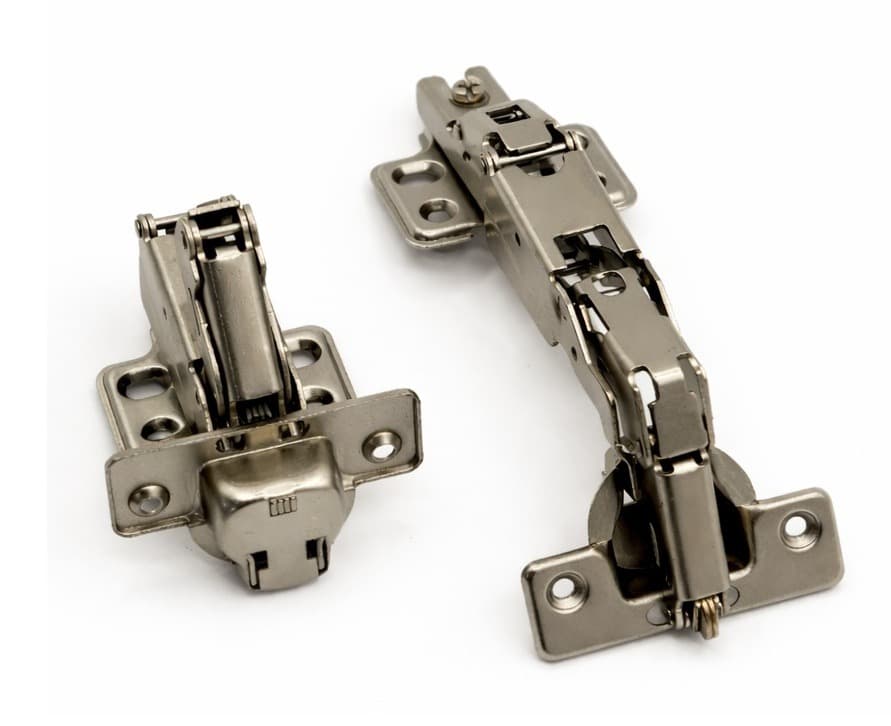
A 165 degree hinge folds the door almost all the way back. Its multi-link arm carries the door out of the carcass opening as it opens. When open it looks like a crocodile's jaws, hence the local name 'timsah' (crocodile) hinge; fitters also call it the 'transformer' hinge. It is needed where the cabinet has a pull-out inside: with a standard hinge the edge of the door stays in the path of the basket or inner drawer, while a wide-angle hinge clears the way. This is why it is fitted to units where a bottle rack or cargo basket sits behind a hinged door.
We stock two versions. The plain 165 degree transformer hinge has no damper, so you close the door by hand to the end. The 165 degree soft-close crocodile hinge closes softly by itself with a built-in damper.
No hinge suits every basket. Before ordering, hang one door, open it fully and pull the basket out: the edge of the door and the hinge arm must not touch it.
Where a 90 degree hinge is used
Two different parts are sold on the market under the name '90 degree hinge', and they are easy to confuse. The first is for a blind corner cabinet: the door hangs not on the side panel but on a fixed front panel (filler panel) standing in the same plane as the door. The arm of this hinge is cranked so that the mounting plate sits on the panel beside the door. The second is a hinge whose opening is limited to 90°: the door does not open further, so that it will not hit a wall, the next unit or the side of a fridge.
The 90 degree hinge in our catalogue is listed as a corner hinge. Before you buy, take it in your hand, look at the crank of the arm and compare it with your own construction. If the door will hang on a fixed panel, you need the first type; if you only want to limit the opening, the second. The safest way is to buy one and try it on an offcut, because a door drilled for the wrong hinge cannot be put right.
Hinge layout in an L-shaped corner cabinet
In an L-shaped corner cabinet the two doors work as a chain. The first door hangs on the side panel of the carcass on 165 degree hinges so that it can fold all the way back. The second door is fixed to the free edge of the first with 135 degree hinges. When opened, the pair folds in the middle, swings aside together and the inside of the corner is fully exposed.
There is one fine point here: the hinges on the carcass carry the weight of both doors. So seat the plates firmly in the board, and take the number of hinges not for one door but for the combined weight of the two. Keep the gap between the two doors as the hinge dimensions require, otherwise the edges will rub against each other as they fold.
After assembly open the doors fully and look: the folded pair must not hit the handle of the next cabinet or a drawer front. Set the gaps with the adjustment screws of the hinge; the procedure is in how to install and adjust cabinet hinges.
What to check when buying a corner hinge
The first question is the damper. A soft-close hinge (locally called 'vakuumlu') has a built-in hydraulic damper and a plain hinge has none; we explained the difference in soft-close vs standard hinges. All the doors in one kitchen should close the same way, so match the corner hinge to the rest.
The second is the mounting plate. Ask whether the hinge is sold with its plate or separately, and whether screws are included. The third is door thickness: measure the diameter and depth of the cup hole from the hinge itself and make sure your door allows for it.
The fourth is a trial fit. Before drilling a whole kitchen, buy one set of corner hinges and assemble it on offcuts, then check the angle, the gap and the opening. After that work out the exact quantity and take it in one go, so that every corner gets the same hinge. Standard hinges and the rest of the hardware can be found in the catalogue.
For an overview of every type, see the furniture hardware guide.
Want to place an order?
You can easily place your orders via WhatsApp.