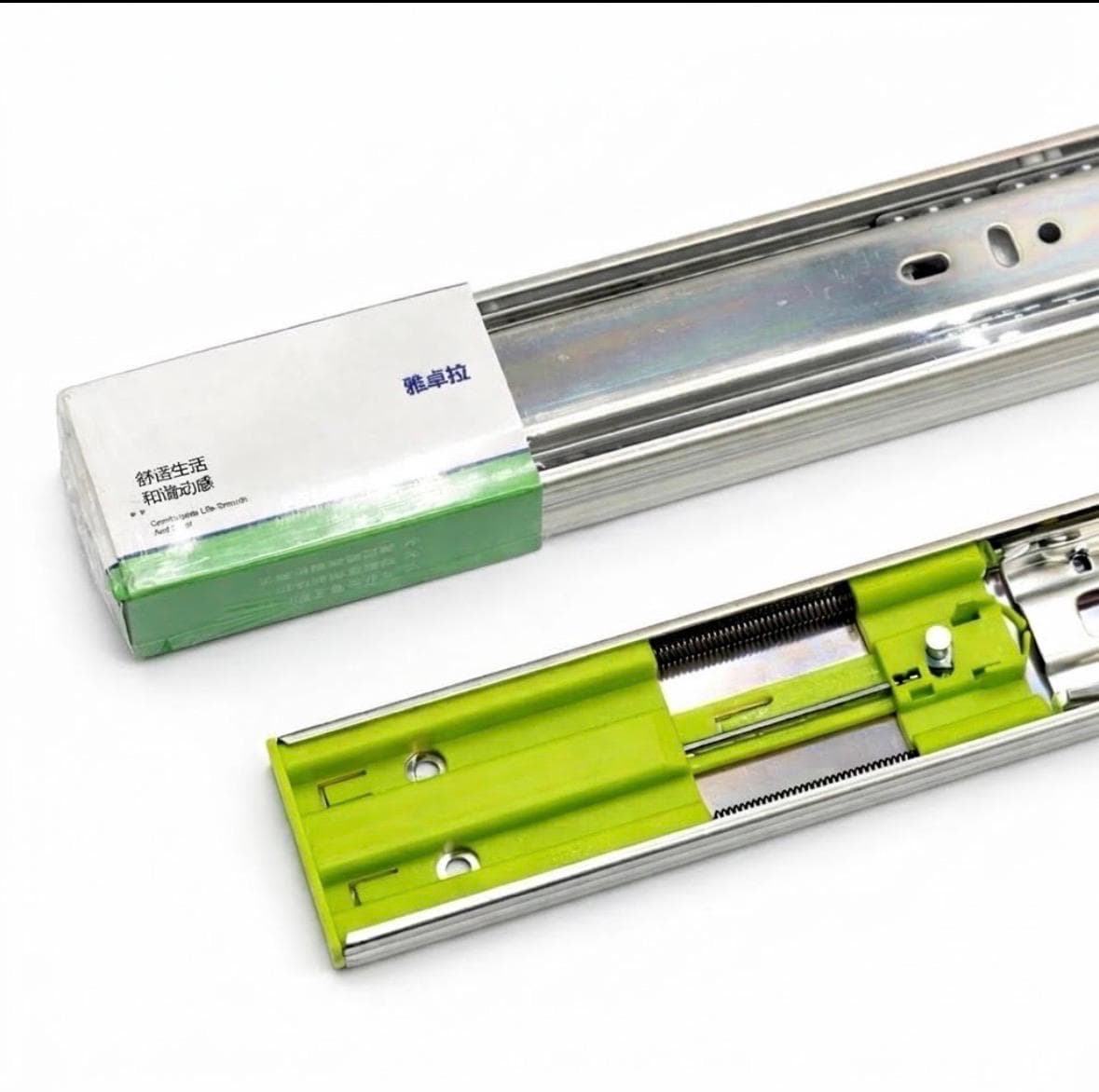


Drawer Slide Length: How to Choose and Size the Drawer
Drawer slide length is chosen like this: measure the inside depth of the cabinet and take the longest standard slide that is at least 10 mm shorter. With side-mounted slides the drawer box is as long as the slide and narrower than the opening by two slide thicknesses. Below, in order: how to take the measurement, which length suits which depth, how to work out the box width, and which lengths we stock.
What slide length tells you
The number 300, 400 or 500 on a slide or in a price list is its closed length in millimetres. Lengths go in 50 mm steps: 200, 250, 300 and so on up to 600 mm. That is why fitters simply say “a 400 slide” or “a 450 slide”; when people ask about drawer slide sizes, this is the number they mean first of all.
The 35 mm and 45 mm that appear in product names are not a length but the height of the slide profile: the 35 mm is called the narrow slide, the 45 mm the wide one. A marking such as “45/300” means a 45 mm profile and a 300 mm length.
Length only sets the depth of the drawer. A longer slide means a deeper drawer, not one that carries more. You can also fit a slide shorter than the cabinet would take; the drawer simply ends up shallower, with unused space behind it.
How to measure the inside depth of the cabinet
Take the measurement inside the carcass: from the front edge of the side panel to the back panel. The outside depth is no use here, because it ignores the thickness of the back panel and how it is set in. If the back panel is recessed in a groove, measure to the panel itself. A 3 m tape measure is all you need; measure at the height where the slide will sit, on both the left and the right, and work from the smaller figure.
If the front is inset, meaning it sits inside the carcass, subtract the thickness of the front from the result: the slide starts behind the front. With an overlay front nothing is subtracted.
Look at what is behind as well. In a kitchen a pipe, a socket, a trap or a gas line can block the drawer's travel; in a cabinet like that, the depth is counted to the obstruction, not to the wall.
The length rule: a slide slightly shorter than the depth
The rule is simple: choose the longest standard slide that is shorter than the inside depth, leaving about 10 mm or more behind it. This is not a figure set by any standard but a practical margin: a back panel is not always perfectly flat, and the slide must not bear against it, or the drawer will not close fully.
Four examples. With an inside depth of 510 mm, take a 500 mm slide. A 480 mm depth takes a 450 mm slide, because 500 does not fit. For 320 mm a 300 mm slide is right, and for 270 mm a 250 mm one.
When the depth comes out exactly equal to a standard length, say 500 mm, there is no margin left; it is safer then to drop one step, to 450 mm. If the type you have chosen is not made in the length you need, you again go one step down.
Drawer box width: clearance for the slide on each side
With side-mounted ball-bearing slides, the slide sits between the drawer and the cabinet side. So the box must be narrower than the opening by two slide thicknesses. For 45 mm ball-bearing slides this clearance is usually about 13 mm per side, 26 mm in total.
An example: a 600 mm cabinet with 18 mm sides has an inside width of 564 mm. Allowing 13 mm each side, the outside width of the box comes to 538 mm.
If the clearance is too small the slides bind and the drawer runs stiffly. If it is too large the slide members pull apart, the drawer rattles and can drop out. So before cutting any board, measure the thickness of the slide you bought yourself, with a caliper or a rule. This applies especially to the narrow 35 mm slide: do not take 13 mm as a given for it.
Drawer depth and height
With side-mounted ball-bearing slides, the drawer box length is taken equal to the nominal slide length: a 450 mm box for a 450 mm slide. If the box is shorter there is nowhere to fix the rear of the slide; if it is longer the drawer will not go into the cabinet.
For height there are two conditions. The drawer side cannot be lower than the slide profile: for a 45 mm slide it must be at least that high. And there must be clearance above and below the box, so that the drawer can be lifted off the slides and put back, and so that the box does not rub on the neighbouring drawer.
The front is larger than the box: it covers both the box and the gaps around it. So derive the box dimensions from what the slide requires and the front dimensions from the external layout of the furniture; they are two separate calculations.
Undermount slides are worked out differently
The width calculation above applies only to side-mounted ball-bearing slides. A soft-close undermount slide sits under the drawer bottom, so the 13 mm rule does not apply to it.
With undermount slides the box width, how far the bottom is set up and the position of the hole in the back panel are fixed by the drawing supplied with the slide. These figures change from model to model, so you cannot apply the drawing for a different slide or a table found online. The only general rule that can be given is this: such slides are typically designed for drawer sides no thicker than 16 mm; the box length, depending on the model, equals the nominal slide length or is about 10 mm shorter, so check that in the drawing too.
Length selection stays the same: the longest slide that is shorter than the inside depth. The construction of the box and the fitting sequence are explained separately in undermount vs ball-bearing drawer slides.
Which lengths are available
What remains is to match the length you have worked out to a product, because not every slide type comes in every length.
The 35 mm standard slide is sold from 200 to 450 mm, and the 45 mm standard slide from 200 to 500 mm. The widest range is the soft-close ball-bearing slide: 200 to 600 mm, so if you need 550 or 600 mm, that is the one. The push-to-open ball-bearing slide covers 300–500 mm. Among undermount slides, the soft-close version comes in 250–550 mm and the push-to-open version in 300–500 mm. The step is 50 mm throughout.
A practical conclusion follows: for a shallow cabinet that will not take a 300 mm slide there is no push-to-open option, and a drawer longer than 500 mm is possible only on soft-close slides. If you have not yet chosen the type, see drawer slide types; all lengths are shown on the product pages in the hardware catalogue.
For an overview of every type, see the furniture hardware guide.
Want to place an order?
You can easily place your orders via WhatsApp.