

 Slides & Mechanisms
Undermount Drawer Slides vs Ball-Bearing Slides
Undermount drawer slides are fixed beneath the drawer, so no metal shows at the sides when it is open; unlike a ball-bearing slide, they need a drawer box built to suit them. This article compares the two slide types, shows the difference between the soft-close and push-to-open versions, and covers the drawer box requirements, the fitting sequence and length selection, so that you know exactly which slide you are working with before you cut any board.
What an undermount slide is and how it is built
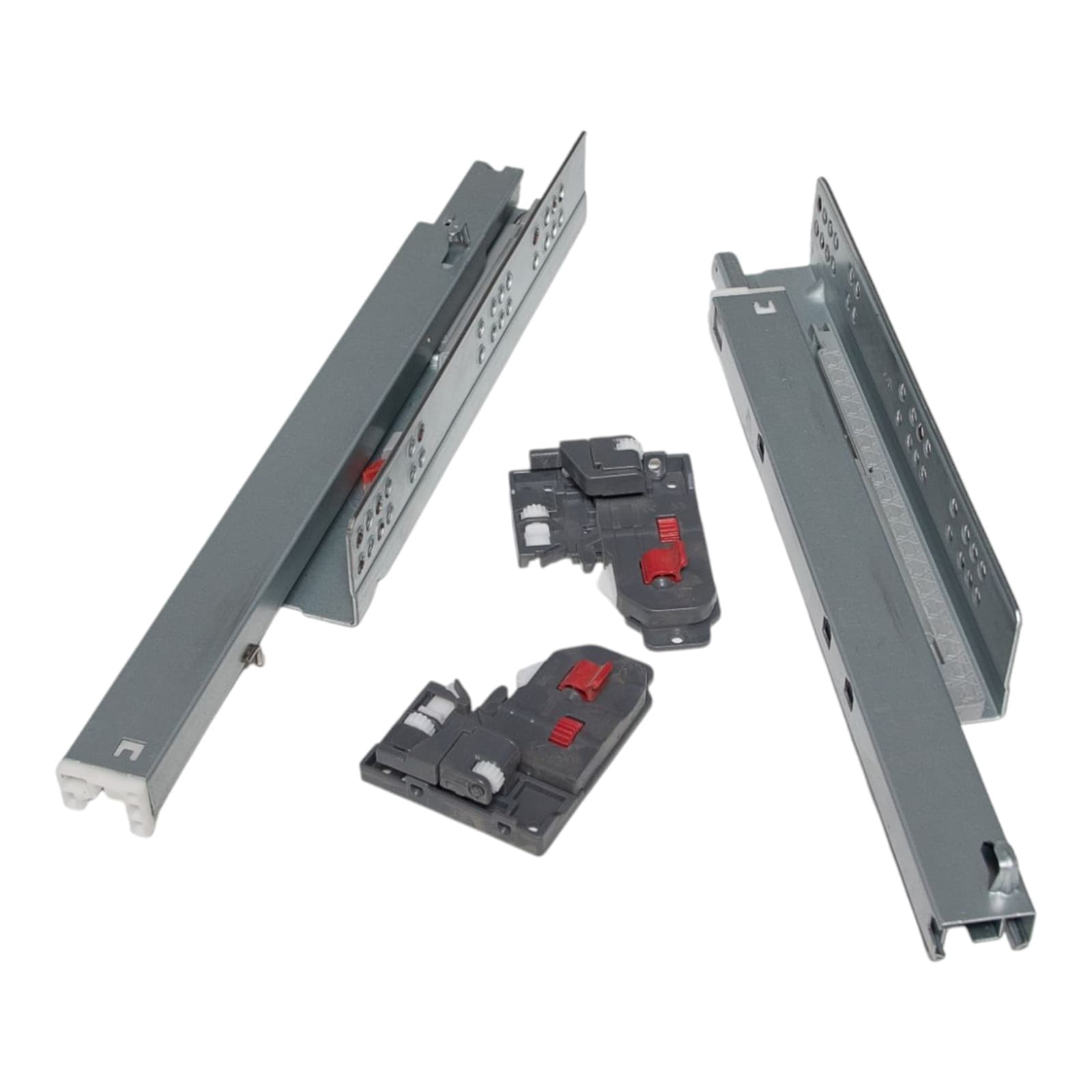
An undermount slide (also called a concealed runner) sits under the drawer bottom rather than on the drawer side. The slide itself is fixed to the cabinet side, the drawer drops onto it from above, and the drawer sides hide it. With the drawer open you see only the timber or chipboard box; no metal rails are visible.
Fitters here often call it a “tandem” slide. That is actually the name of one manufacturer's product line, which in everyday speech has spread to every undermount slide. The slides in our shop are not that brand's product: they come from a different manufacturer and work on the same principle. So another manufacturer's drawing or locking clip may not fit them; always take dimensions from the slides you actually bought.
The same kind of slide is used in ready-made fittings too: the basket of the pull-out cargo unit on undermount slides, for example, runs on exactly this type.
Main differences from a ball-bearing slide
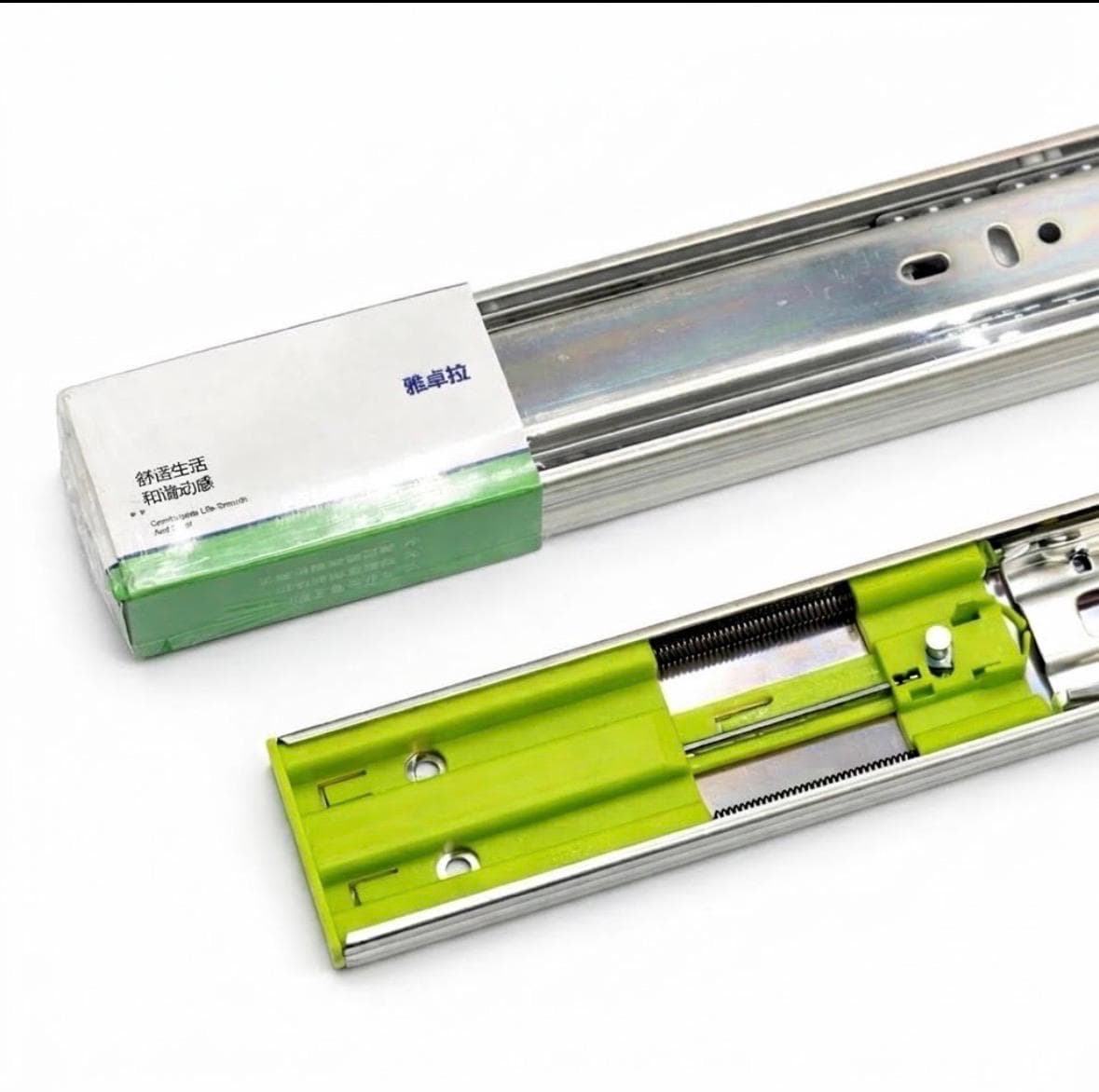
A ball-bearing (telescopic) slide is screwed to the side of the drawer, so with the drawer open a strip of metal shows on both sides. With undermount slides the sides stay clean. That is the main visual difference.
The second difference is the box. Ball-bearing slides such as the 45 mm telescopic slide go on any box with flat sides; you only leave a gap for the slide on each side. An undermount slide makes demands on the box itself: the bottom is set up into the box, notches are cut at the back, and clips are screwed under the front.
The third difference is where the space comes from. A ball-bearing slide takes it from the drawer width; an undermount slide sits under the bottom and takes it from the internal height. Removing the drawer differs too: on ball-bearing slides you press the plastic levers at the sides, on undermount slides you squeeze the clips underneath and lift the drawer. In price, undermount slides cost more than plain ball-bearing ones. For an overview of every type, see drawer slide types.
Two versions: soft-close and push-to-open
Undermount slides are sold in two versions, and the choice depends on how the front will be opened.
The soft-close undermount slide is for drawers with handles or a profile handle. Its built-in hydraulic damper catches the drawer over the last few centimetres and closes it by itself without a bang. You pull the drawer open by hand, so the front needs something to grip.
The push-to-open undermount slide is for handleless fronts. You press lightly on the front and the mechanism pushes the drawer out. For that to work there must be a gap between the front and the carcass for the press travel; without it the mechanism does not release.
A drawer takes one version or the other, not both: either soft closing or push opening. If the design has handleless fronts, decide the opening method in advance; other kinds of push latch are described in push-to-open latches.
Drawer box requirements
A drawer box for undermount slides is designed in advance around the specific slide. Four things need attention.
Side thickness is limited: slides of this kind are typically designed for drawer sides no thicker than 16 mm. The bottom does not sit flush with the lower edge of the box but is housed in a groove slightly higher up, so the slide is hidden beneath it. Notches for the slide are cut in the lower corners of the back panel, and the back panel itself gets a hole for the slide's rear hook. Clips are screwed under the front, in the left and right corners: they hold the drawer on the slides and later let you adjust the front.
How far to set the bottom up, where to drill the hole and how wide the box must be all vary from model to model, so we give no figures here. Take those dimensions from the drawing supplied with the slides, and do not cut the whole set until you have built one trial drawer.
Fitting sequence
First the slides are fixed to the cabinet sides. The set-back from the front edge and the height are given in the drawing; the essential condition is that the left and right slides sit at the same height and parallel to each other. The simplest way is to mark both sides from the same template.
Then the clips are screwed under the drawer, behind the front. Place the drawer on the slides and push it all the way in: when the clips catch the slides there is a clear click. If there is no click the drawer has not seated; do not pull on it, but lift it off and check that the rear hooks have entered their holes.
Last, the front is adjusted. The adjuster on the clip raises and lowers the front, and on some clips the sideways position can be adjusted as well. Even up the gaps with the neighbouring fronts, and on the push-to-open version check that the press gap is the same all round.
Choosing the length
The soft-close undermount slide is sold in lengths of 250, 300, 350, 400, 450, 500 and 550 mm; the push-to-open version runs from 300 to 500 mm in 50 mm steps.
The selection rule is the same as for other slides: measure the internal depth of the cabinet and take the longest slide that fits. An undermount slide needs room at the back for the slide itself and its hook, so check the minimum cabinet depth in the drawing. The drawer box length depends on the model: for some undermount slides it equals the nominal slide length, for others the box is made about 10 mm shorter. Take the exact figure from the drawing and build one test box first.
Kitchen base cabinets usually take 450 or 500 mm slides; shallow cabinets and chests of drawers take shorter ones. How to measure the depth, with worked examples, is covered in drawer slide length.
When to use undermount and when ball-bearing
Undermount slides earn their place where a drawer is opened often and its inside is on show: kitchen base drawers, a bedroom chest of drawers, internal wardrobe drawers. In handleless designs the push-to-open undermount slide provides both the opening mechanism and the runner in one fitting.
Ball-bearing slides make more sense elsewhere: office and utility furniture, jobs on a tight budget, and repairs to an existing drawer. Converting a finished box to undermount slides usually means rebuilding it, whereas a ball-bearing slide goes onto the old box as it is. If you want soft closing, there is no need to change the box for it: a soft-close ball-bearing slide does the same job, only with the metal visible at the sides.
Using both in one piece of furniture is perfectly normal: undermount for the drawers on show, ball-bearing for internal and secondary drawers. Every slide type, with its available lengths, is in the furniture hardware catalogue.
For an overview of every type, see the furniture hardware guide.
Want to place an order?
You can easily place your orders via WhatsApp.