

 Kitchen & Wardrobe
How to Choose a Stainless Steel Kitchen Sink
Choose a stainless steel kitchen sink in three steps: the cabinet it must fit, one bowl or two, drainer or not, and a satin, polished or black surface. Neither colour nor shape will rescue a sink that is the wrong size. Below we go through the sizes of the sinks in the catalogue one by one — 77×49, 77×50, 80×46 and 80×50 cm — and explain how right-hand and left-hand drainers are defined, what the cut-out and the silicone do during fitting, and how to look after the sink day to day.
Measure the Cabinet First: Which Module the Sink Fits
A sink has two sizes and each has to fit in a different place. The outer size (80×50 cm, for example) is the space it takes on the worktop; the bowl itself drops below the worktop and has to go between the two side panels of the sink cabinet. So measure the inside width of the cabinet first: on a 600 mm module in 16 mm board that is 568 mm. Then turn the sink over, measure the outer width of the bowl from underneath and leave room for the fixing clips as well.
The depth of the worktop is the second limit. On a standard 60 cm worktop a 46–50 cm sink leaves a strip at the front and at the back; a very narrow strip weakens the worktop. Decide now, too, whether the tap will stand on the sink's own ledge or in a hole drilled in the worktop.
Plan the inside of the cabinet as well: measure whether there is room left for a pull-out waste bin on runners once the trap and pipes are in. A double-bowl sink takes up more space underneath.
Single Bowl, Double Bowl and Sinks with a Drainer
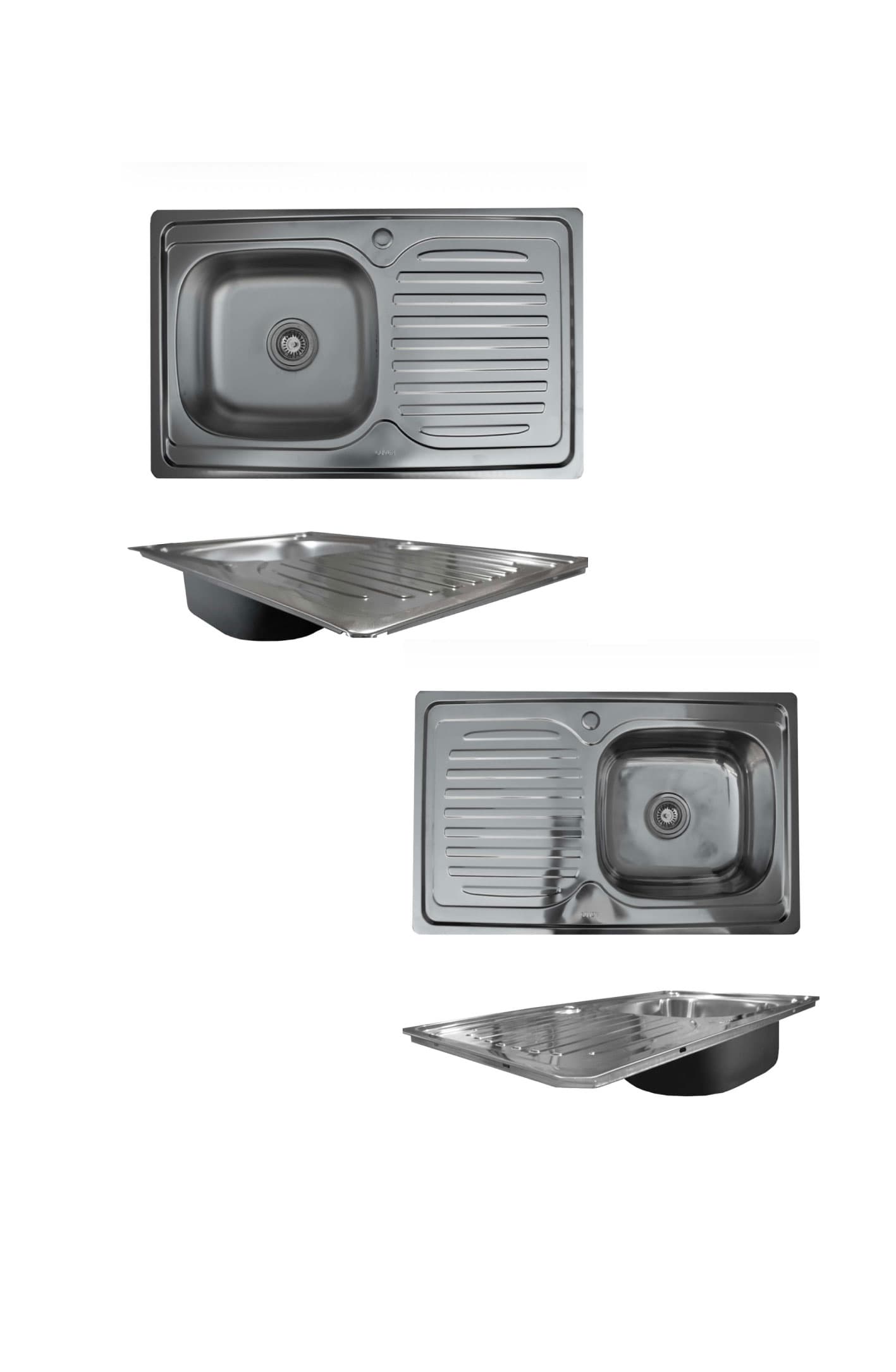
A sink with a drainer is a widespread choice for general use: beside the bowl there is a draining area from which water off the washed dishes runs back into the bowl. In the catalogue this group includes the 80×50 cm sink, sold with a right-hand or left-hand drainer, and model 7750 with a single oval bowl. The drainer keeps water off the worktop, but you lose that area as a work surface.
In a double-bowl sink you wash in one bowl and rinse in the other, or soak dishes in one and keep the other free. The polished 77×49 cm model and the satin 80×46 cm model are double-bowl sinks. They have no drainer, so they need somewhere beside them to dry dishes, or a dish rack above. Two bowls in the same length are narrower than one, so a large frying pan or a baking tray does not fit comfortably.
The black sink with one rectangular bowl comes with a metal strainer basket inside; fitters call it a square sink with a basket. The basket is used for washing vegetables and draining dishes.
Right-Hand or Left-Hand Drainer: How It Is Defined
Three models in the catalogue — the 80×50, the oval 7750 and the black sink — are sold with a right-hand or left-hand drainer. The side is normally defined standing in front of the sink and facing it: a right-hand drainer means the draining area is on your right and the bowl on your left. The term is sometimes used the other way round, so when ordering, look at the product photo or simply ask which side the bowl is on.
The side is decided by the kitchen layout. The bowl should be close to the waste outlet and to the wall cabinet with the dish rack, while the drainer runs towards the free worktop. Do not push the bowl hard against a side wall: there is no room for your elbow and water splashes the wall. Having the drainer between the sink and the hob is convenient, because it keeps splashes away from the hob. The size of the wall cabinet is covered in the guide to in-cabinet dish rack sizes. Getting the side wrong is expensive: once the worktop is cut, the sink cannot be turned the other way.
Satin, Polished and Black Surfaces: The Difference in Daily Use
A polished surface looks like a mirror when new, but every drop of water leaves a spot as it dries, and fine scratches show in the light. A sink like this has to be wiped after every use. In the catalogue the 77×49 cm double-bowl model is the polished one.
A satin surface has a fine pattern running in one direction, which hides both water marks and everyday scratches better. The 80×46 cm double-bowl model has a satin surface. That does not mean a satin sink cannot scratch or mark: stainless steel resists corrosion, but limescale and scratches are possible on both surfaces.
On a black sink the colour comes from a coating over the steel. On a dark surface the white trace of limescale shows sooner than on a light sink, and abrasive cleaners can damage the coating. A black sink therefore needs gentler care, and the main reason to choose it is its look. The steel grade and thickness are not given in the catalogue; if they matter to you, ask the seller.
Sizes: 77×49, 77×50, 80×46, 80×50
The first number is the length of the sink along the worktop, the second its width from front to back. 77×49 cm is the size of the polished double-bowl model. Both bowls drop below the worktop along the whole length, so both must fit inside one cabinet; that calls for a wide module.
77×50 cm is model 7750 with an oval bowl and a drainer; the 80×50 cm drainer model is 3 cm longer. With a drainer sink only the bowl goes into the cabinet. The drainer is shallow and usually does not drop below the thickness of the worktop, so it can run over the neighbouring cabinet. On a thin worktop, be sure to check this by measuring.
80×46 cm is the satin double-bowl model. Because it is 46 cm from front to back, it leaves wider strips of worktop at the front and back; this helps when room is needed for a tap behind the sink or when the worktop is narrower than 60 cm. Confirm with the seller before ordering the outer size of the black sink and exactly which cabinet width each model fits.
Fitting: Cut-Out, Silicone and Protecting the Edge
This sequence applies to sinks that are cut into the worktop. Mark the cut-out with the template from the box; if there is no template, do not guess the size: turn the sink over, draw round it and cut inside the line by the width of the rim that rests on the worktop. First make sure the side panels of the cabinet and its front rail do not fall on the cutting line. Drill holes in the corners, cut with a jigsaw and support the waste piece from below, so it does not break away at the end and tear the laminate.
The cut chipboard edge is the weak point of the worktop: if water reaches it, the board swells and the rim lifts. Coat the cut with silicone all the way round. Then run a continuous, unbroken bead of sanitary silicone under the rim; unlike ordinary universal silicone, it contains an anti-mould additive. Seat the sink, tighten the clips evenly in a criss-cross order and wipe off the squeezed-out silicone straight away. After connecting the trap, fill the bowl with water and look underneath for leaks.
Care Rules
After use, rinse the sink with clean water and dry it with a soft cloth. Most marks are not dirt but limescale left by water as it dries; wipe it off with a weak solution of vinegar or citric acid, then rinse with water. Wipe a satin surface along the direction of the pattern.
Do not use steel wool or a wire brush: tiny particles from them stay on the surface and rust, and the sink itself appears to have rusted. Do not leave chlorine bleach or salty water standing in the bowl for long; do not leave a wet cast-iron pan or a tin can in the sink overnight either, as they leave a rust mark underneath.
On a black sink use only a soft sponge and liquid detergent: abrasive powder and a hard sponge scratch the coating. Wipe away the water left under the basket too. Sinks and other kitchen fittings are in the catalogue, and the full list is in the kitchen hardware checklist.
For an overview of every type, see the furniture hardware guide.
Want to place an order?
You can easily place your orders via WhatsApp.