


 Kitchen & Wardrobe
In-Cabinet Dish Rack Sizes: Choosing 50–100 cm
An in-cabinet dish rack is bought by the width of the wall cabinet it goes into: 50, 60, 70, 80, 90 or 100 cm. The size names the cabinet module, not the width of the wire shelf. This article explains how to check the inside width and depth of the cabinet and the height between the tiers, which width is taken for which household, and when a lift-down rack on a mechanism is worth it. It ends with short rules for fitting and everyday care.
What an In-Cabinet Dish Rack Is and What It Consists Of
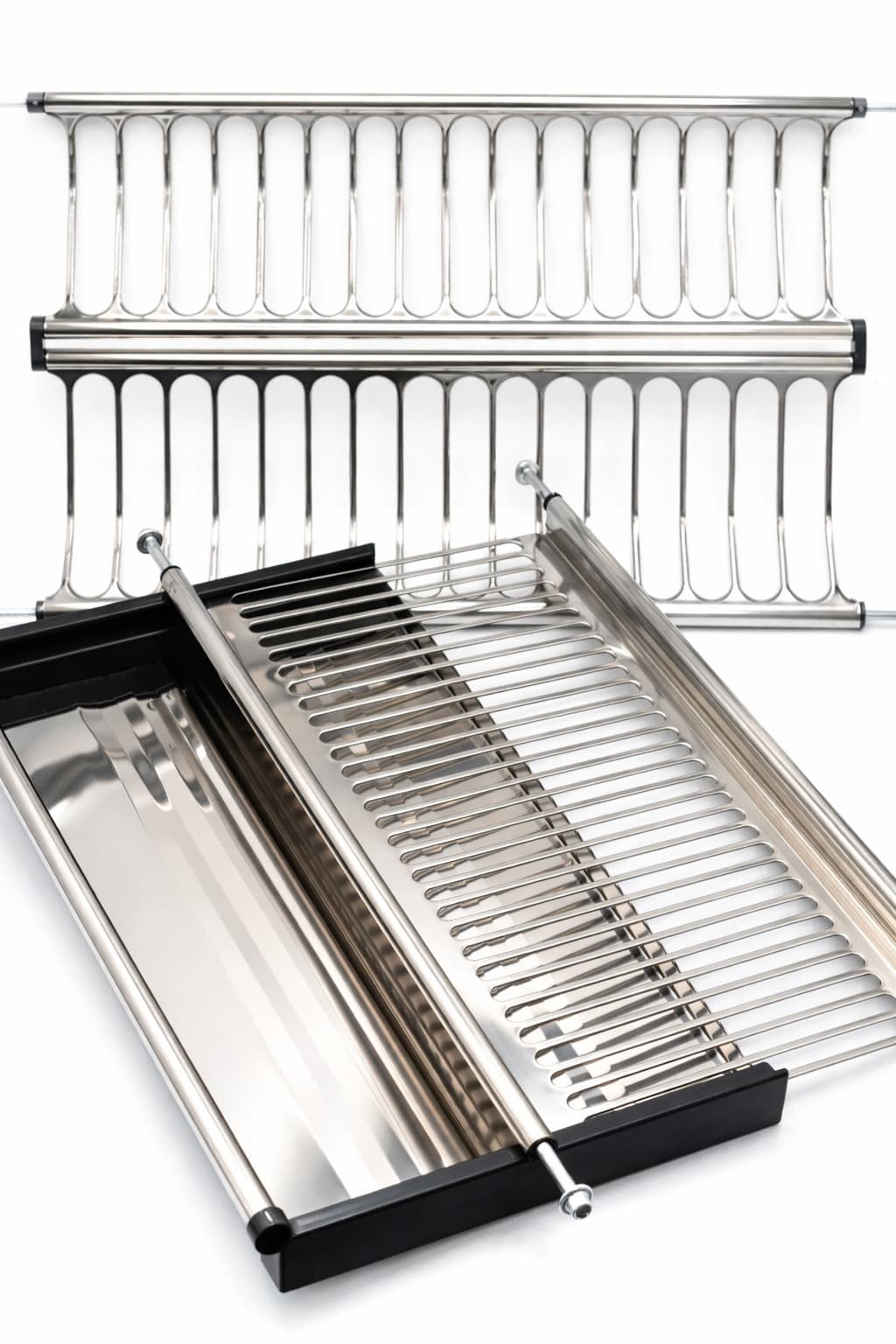
An in-cabinet dish rack is a set of wire shelves fitted inside a kitchen wall cabinet, usually above the sink. In Azerbaijani it goes by several names — quruducu, suşilka, sometimes suşilqa — and in Russian it is «сушка для посуды». The in-cabinet dish rack has two tiers: below, a shelf where plates stand upright; above, a shelf for glasses and cups. At the very bottom sits a removable drip tray that collects the water running off the dishes. The catalogue gives the material as metal.
The shelves rest on holders fixed to the side panels of the cabinet, which is why the width of the rack is tied to the width of the cabinet. Its position is set by the sink: to put a washed dish on the shelf without taking a step, the rack cabinet should be over the bowl or right next to it. With a right-hand or left-hand drainer model, such as the 80×50 cm stainless sink, it is more convenient when the cabinet comes over the bowl rather than the drainer. More on this in the guide to choosing a stainless steel sink.
50, 60, 70, 80, 90, 100 cm: The Size Follows the Cabinet Width
The size of a dish rack names the module it goes into, not its own width. A 60 cm rack is for a cabinet 60 cm wide; the wire shelf is narrower by the thickness of the two side panels. A 600 mm cabinet is 568 mm wide inside when built from 16 mm board and 564 mm when built from 18 mm board. The difference is only 4 mm, but it is exactly what decides whether the shelf seats or not.
So before ordering, measure the inside width of the cabinet with a tape — from the inner face of one side panel to the other — and do not rely on the label alone. When buying, ask which board thickness the rack is made for. If the cabinet is not built yet, it is safer to work the other way round: buy the rack first, measure the shelf and cut the cabinet to suit. The catalogue has 50, 60, 70, 80, 90 and 100 cm; if your cabinet is an in-between width (65 cm, say), a ready-made rack will not seat in it properly.
Is the Cabinet Deep and Tall Enough
Even when the width is right, a large plate may not fit. Measure the diameter of the biggest plate in the house; a large dinner plate is usually 26–28 cm. The plate stands upright on the shelf, so the inside depth of the cabinet — from the back panel to the inner face of the door — has to be greater than that diameter, or the door will not close. Wall cabinets are often shallow, which makes this the dimension that most often falls short.
The same check applies to height: between the plate shelf and the glass shelf there must be room for the height of the plate plus a few centimetres for your hand. Before fixing the holders, stand a plate in place and mark from it.
The type of door matters too. With a lift-up door the gas strut is fixed to the side panel and must not clash with the shelf holders. How many newtons the door weight calls for is explained in the guide to choosing cabinet gas struts.
Which Size for Which Household
There is no norm here, only habit. For one or two people, or in a kitchen with a dishwasher, a 50–60 cm rack is usually enough: it mostly takes what is washed by hand — a few plates, cups and lids. A family of three or four most often takes 80 cm; it holds a day's set of dishes in one go. 90 and 100 cm make sense where there is wall space and the dishes not only dry in the rack but are stored there permanently.
The kitchen layout limits the choice as well. The rack cabinet is often made the same width as the sink cabinet below it, so that the vertical lines of the upper and lower rows coincide. A cabinet wider than 80 cm usually has two doors, and a loaded wide shelf can sag in the middle; so on a wide rack look at the thickness of the wire and whether there is a support in the middle.
Who Needs a Lift-Down Rack on a Mechanism
In an ordinary rack you have to reach up to the top shelf; if the wall cabinet hangs high or the user is short, the upper tier is hardly used in practice. In a lift-down dish rack the shelves sit on a strut-assisted lifting mechanism: you pull the shelf down, both tiers come to hand height, and when you have finished you push it back up. This model also has a drip tray at the bottom.
Check three things before buying. First, the worktop must be clear where the shelf comes down: a tall tap, a kettle or an appliance must not block its path. Second, the mechanism passes the load to the side panels of the cabinet, so the cabinet must be hung firmly on the wall and the side panels must be undamaged. Third, the catalogue lists two sizes of this model; ask the seller which cabinet width each one suits. It costs considerably more than an ordinary rack, so it makes sense where it is really needed — in a high cabinet.
Fitting and Protecting the Cabinet from Moisture
Fix the holders at the same height on both side panels: measure the distance from the bottom edge of the cabinet with a tape and check with a spirit level. If one side is a few millimetres lower, the water in the tray gathers in one corner and spills over. Mark the lower tier first, then stand a plate in place and mark the upper tier. The tray must always be in place; without it the water runs straight onto the bottom and the lower edge of the cabinet.
Laminated chipboard stands up to water on its face but soaks it up through a cut edge and swells. So cover the exposed places on the lower edges of the cabinet and around holes with PVC edge banding, or seal them with sanitary silicone. This lowers the risk but does not protect the cabinet completely: the main protection is letting dishes drain before racking them and emptying the tray in good time.
The cabinet has to be able to air. Some fitters build the rack cabinet without a bottom panel, others advise leaving the door ajar for a while. In a closed, damp cabinet both the board and the wire deteriorate quickly.
Care: Preventing Stains and Limescale
The main cause of stains and rust on a wire shelf is the water left standing on it. Once a week wipe the shelves and holders with a dry cloth, paying attention to the points where the wires cross and are welded: that is where water lingers longest. Emptying the tray every day should become a habit; a tray left with water in it develops a ring of limescale within a few days.
Soften limescale with a solution of vinegar or citric acid in warm water, rinse after ten to fifteen minutes and wipe dry. Do not use steel wool, the hard side of a sponge or abrasive powder: they scratch the coating, and rust starts from a scratch. Do not leave chlorine-based cleaners on the shelf either.
To be honest, no wire rack tolerates standing in water for long; whatever it is made of, a shelf that is kept dry lasts longer. When the shelves wear out there is no need to replace the cabinet: a new rack of the same width can be picked from the catalogue.
For an overview of every type, see the furniture hardware guide.
Want to place an order?
You can easily place your orders via WhatsApp.