

 Fasteners & Materials
PVC Edge Banding: 0.4 mm vs 0.8 mm
0.4 mm PVC edge banding is for edges that are neither seen nor knocked; 0.8 mm is for visible, frequently touched edges such as fronts. Below we explain where each thickness is used, which board the 22 mm width suits, how to choose the colour and how to work out how many metres of banding an order needs, with brief notes at the end on applying the band and trimming the edge.
What edge banding is for
When laminated chipboard or MDF is cut, the edge is left raw: you can see the chips or fibres, and it crumbles when touched. PVC edge banding covers that cut. It does three jobs: it gives the furniture a finished look, protects the edge from knocks and chipping, and makes it harder for moisture to get into the core of the board. The last matters most in kitchen and bathroom furniture, because chipboard that takes up moisture swells. But the band alone does not give complete protection: the glue line matters at least as much as the band itself.
The same material goes by several names: edge banding, edge tape, and locally kənar lenti, kənar bant or kromka. In price lists you will meet the abbreviations “0422” and “0822”: they stand for 0.4 × 22 mm and 0.8 × 22 mm, that is, thickness and width.
0.4 mm band: where it is enough
The 0.4 mm band is thin and flexible, lies close to the edge and adds almost no thickness. It belongs on edges that are hidden or rarely touched: the back edges of the carcass, top and bottom edges out of sight, internal shelves and partitions. For the front edge of a shelf behind a door, 0.4 mm is usually enough as well.
Thin band has a weak side too: it dents easily when knocked and lifts sooner at corners, and if the cut is rough the unevenness of the board shows through it. That is why it is not used on fronts or on edges that hands touch.
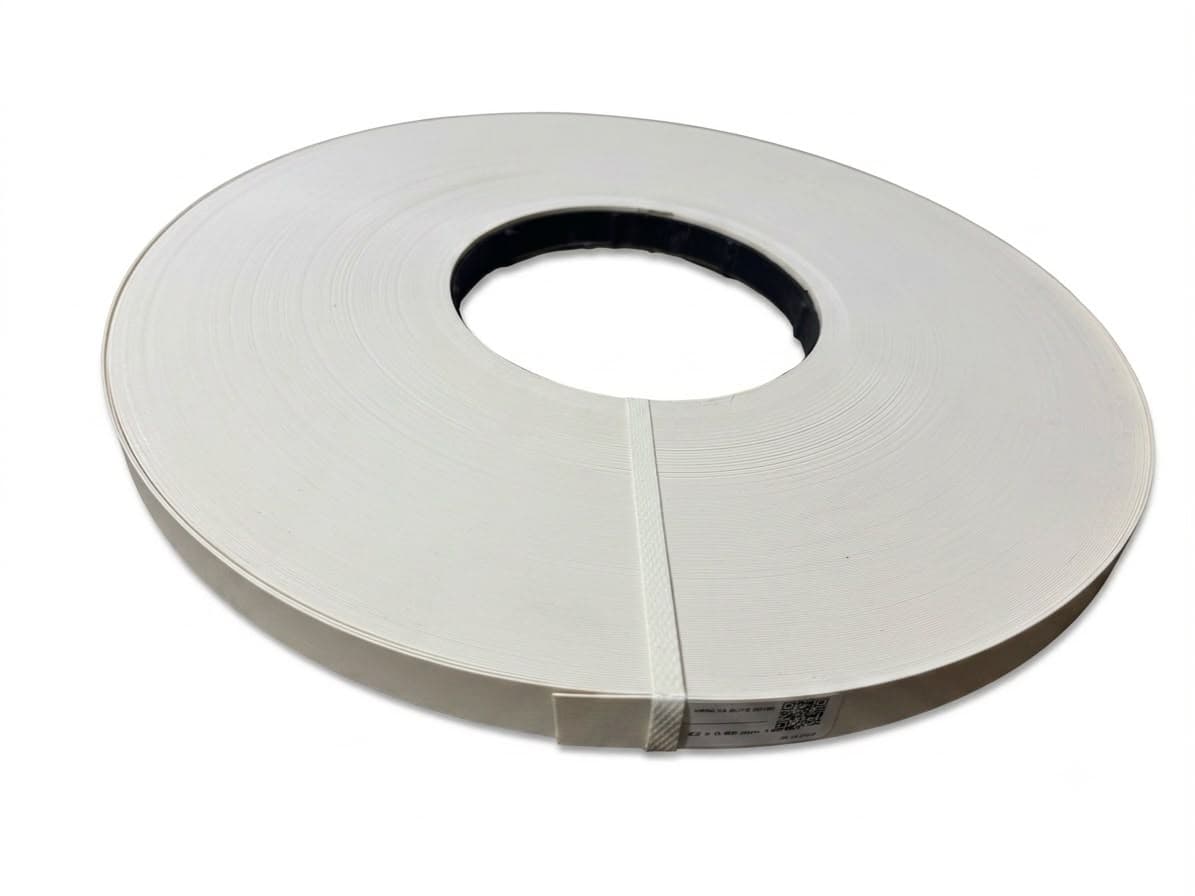
We stock 0.4 × 22 mm band in three colours: White Bute 0.4 mm, Vanilla 0.4 mm and Anthracite 0.4 mm. All three are sold in 300-metre rolls.
0.8 mm band: visible and impact-prone edges
The 0.8 mm band is twice as thick, so it stands up better to knocks, abrasion and chipping. It belongs on edges that are on show and often touched: all edges of door and drawer fronts, the visible front edges of the carcass, and edges at worktop height that get caught by a bag, a chair or a broom.
One thing to know in advance: 0.8 mm band does not give the rounded, full edge of a thick 2 mm band. It is tougher than thin band, but the edge still stays square, with a crisp arris.
In this thickness, White Bute 0.8 mm, Vanilla 0.8 mm and High Gloss White are sold in 150-metre rolls, and Metallic Grey in a 120-metre roll. The roll is half the length of a 0.4 mm roll, so the cost per metre is noticeably higher; for that reason it is counted only for the edges that really need it.
Which board the 22 mm width suits
All the banding in the shop is 22 mm wide. That width is intended for boards 16 and 18 mm thick, so it covers the two thicknesses most used in cabinet furniture.
The band is deliberately wider than the board. On an 18 mm board about 2 mm overhangs on each side, on a 16 mm board about 3 mm. This allowance makes up for the band drifting slightly sideways as it is applied; once the glue has cooled, the overhang is trimmed flush with the face of the board. If the band were the same width as the board, the slightest drift would leave a strip of the edge exposed.
The limitation follows from this: 22 mm band will not cover thicker parts, such as a doubled-up board or a thick worktop. For those you need a wider band.
Choosing the colour: White Bute, High Gloss White, Vanilla, Anthracite, Metallic Grey
The band is matched to the board decor on two counts: colour and sheen. With white boards the mistake is most often made on the second. White Bute is a matt white with a light texture and goes with ordinary white laminated board. High Gloss White is meant for boards with a mirror-like glossy surface; on a matt board such an edge stands out as a separate stripe.
Vanilla is a warm cream tone, Anthracite a dark grey, Metallic Grey a silvery grey. Shades of white and grey differ from one manufacturer to another, so the most reliable check is to hold the roll against the board and compare them in daylight.
The choice is not the same in both thicknesses. White Bute and Vanilla come in both, so the carcass can be banded in 0.4 mm and the fronts in 0.8 mm in one colour. Anthracite comes only in 0.4 mm; High Gloss White and Metallic Grey only in 0.8 mm.
How many metres you need: a simple calculation
Do the calculation separately for each thickness. On the cutting list, mark the edges to be banded, add up their lengths and put 10–15 percent on top as a reserve: a few centimetres of band are cut off at the start and end of every part, and some material goes on setting up the machine.
An example. A 700 × 400 mm door has four edges totalling 2.2 metres. If the kitchen has 20 such fronts, you need 44 metres of 0.8 mm band, or about 50 metres with the reserve. So one 150-metre roll covers the fronts of three kitchens like this.
Count the 0.4 mm band for the carcass the same way: back and hidden edges, internal shelves and partitions. Compare the result with the 300-metre roll. When the colour changes the calculation starts again, because each decor has its own roll.
Applying the band and cleaning up the edge
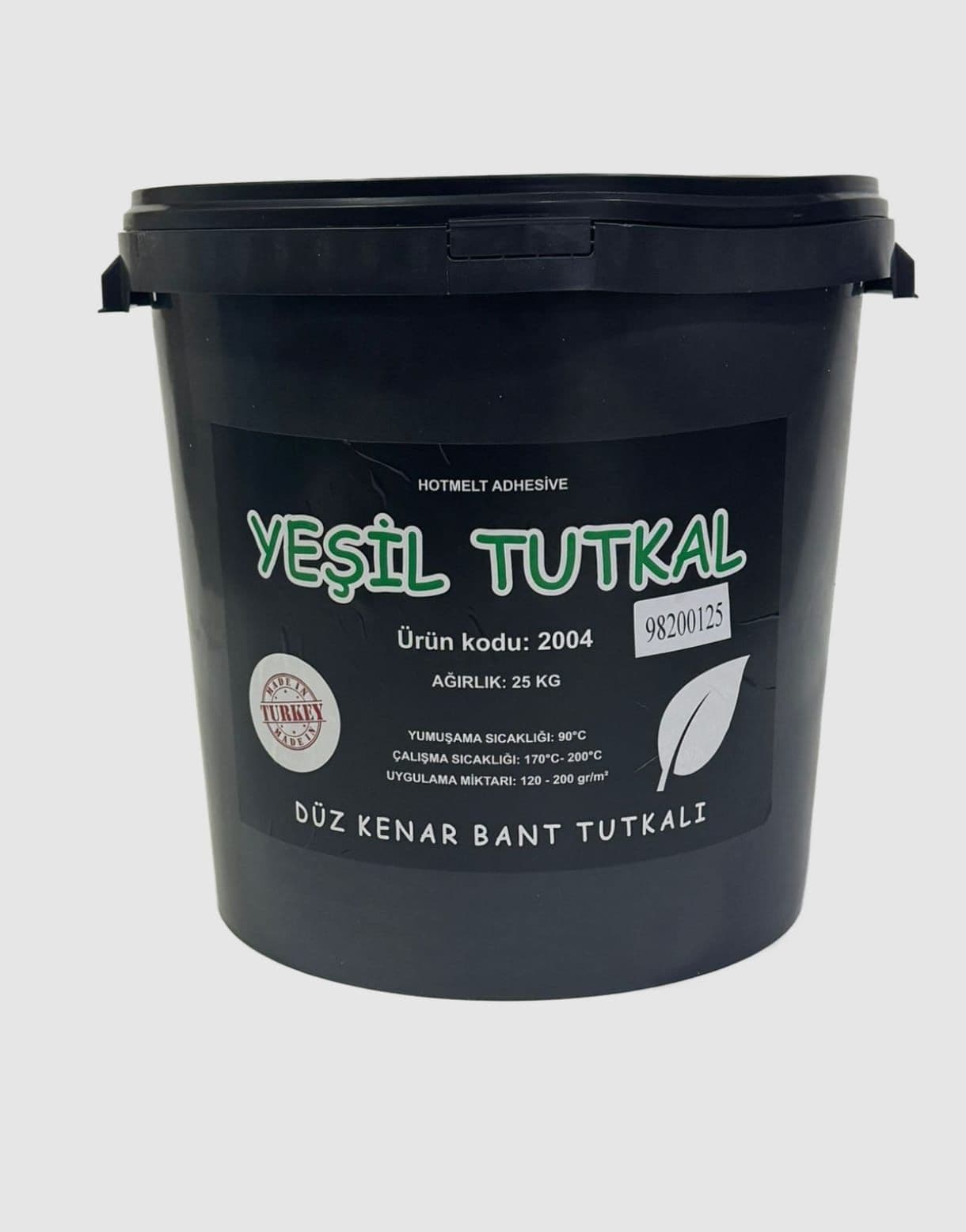
This banding is intended for automatic and semi-automatic edge-banding machines. The machine spreads molten glue on the edge of the board and presses the band onto it. The glue used is granular EVA hot-melt adhesive, sold in a 25 kg pail. If you are looking for band with a ready glue layer that is ironed on, ask about that separately before ordering.
After the band is applied, two operations remain. First the start and end of the band are cut flush with the end of the part, then the overhang is removed top and bottom. On a machine the cutters do this; in hand work it is done with a sharp utility knife or an edge trimmer. A blunt blade does not cut the band but tears it and damages the laminate face, so change the blade in good time.
For choosing glue and working out consumption, see edge-banding hot-melt glue; all the banding is in the hardware catalogue.
For an overview of every type, see the furniture hardware guide.
Want to place an order?
You can easily place your orders via WhatsApp.