

 Fasteners & Materials
Edge Banding Hot-Melt Glue (EVA): Choice and Usage
Edge banding hot-melt glue is an EVA adhesive in granules: one type is for straight-line machines and another, with a lower working temperature, is for curved edges. In local workshops it is called tutkal, kley or simply hotmelt. This article shows how the glue works, how the types for straight and curved edges differ, why working temperature matters and roughly how many metres of edge 25 kg will cover. At the end we explain the causes of common defects and the rules for storage.
What EVA hot-melt is and how it works
EVA (ethylene-vinyl acetate) hot-melt is a solid granule at room temperature; it melts when heated and hardens again as it cools. It contains no solvent that has to dry: the bond is formed by cooling alone. In an edge banding machine the granules are poured into the glue pot and melt there, and a roller spreads the melt in a thin layer on the edge of the board. Straight afterwards the band is pressed onto that edge, and the glue cools and holds it.
Two things follow from this. First, time is short: the glue starts to cool as soon as it is applied, so temperature, feed speed and pressure have to match each other. Second, a cold board draws the heat out of the melt quickly and the bond is weaker.
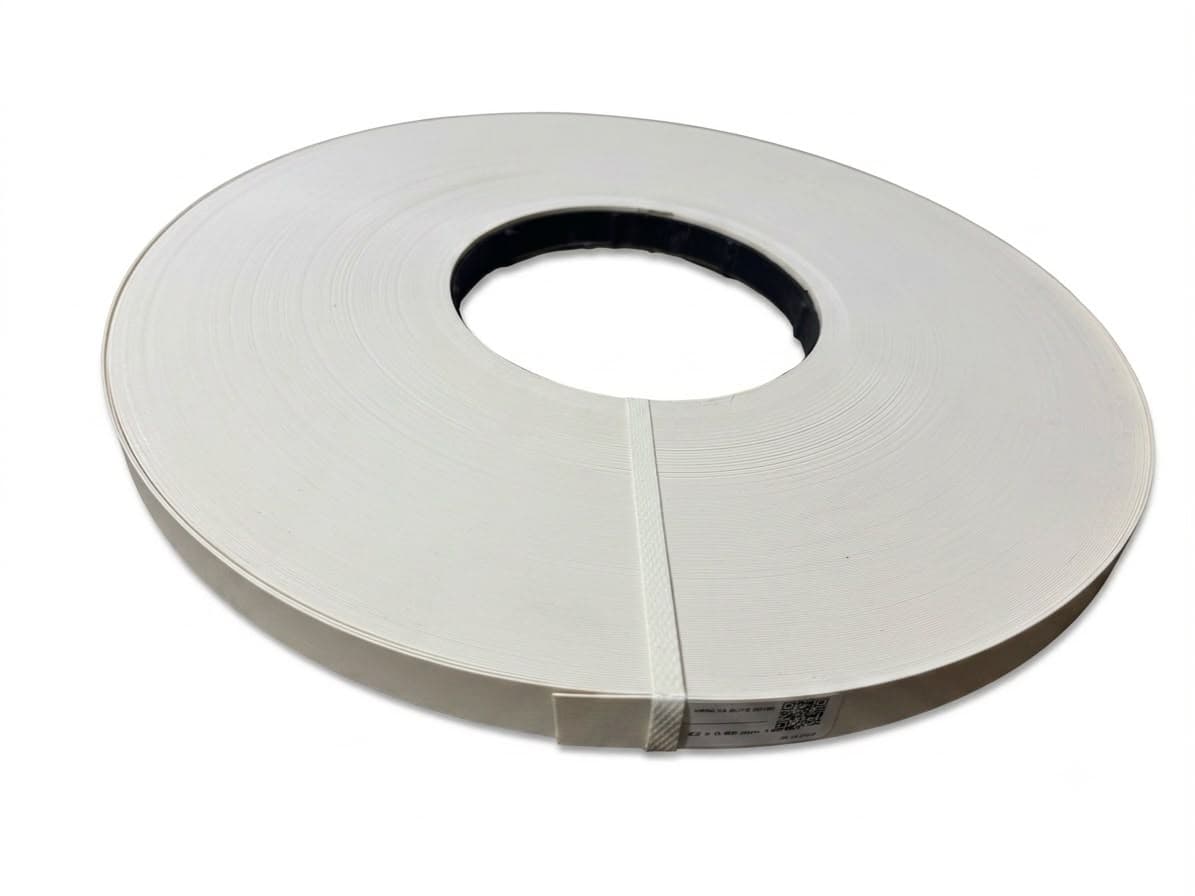
This glue is used with both thin 0.4 mm PVC edge band and thick 0.8 mm edge band. For how to choose the band thickness, see PVC edge banding: 0.4 mm vs 0.8 mm.
Glue for straight edges: automatic and semi-automatic machines
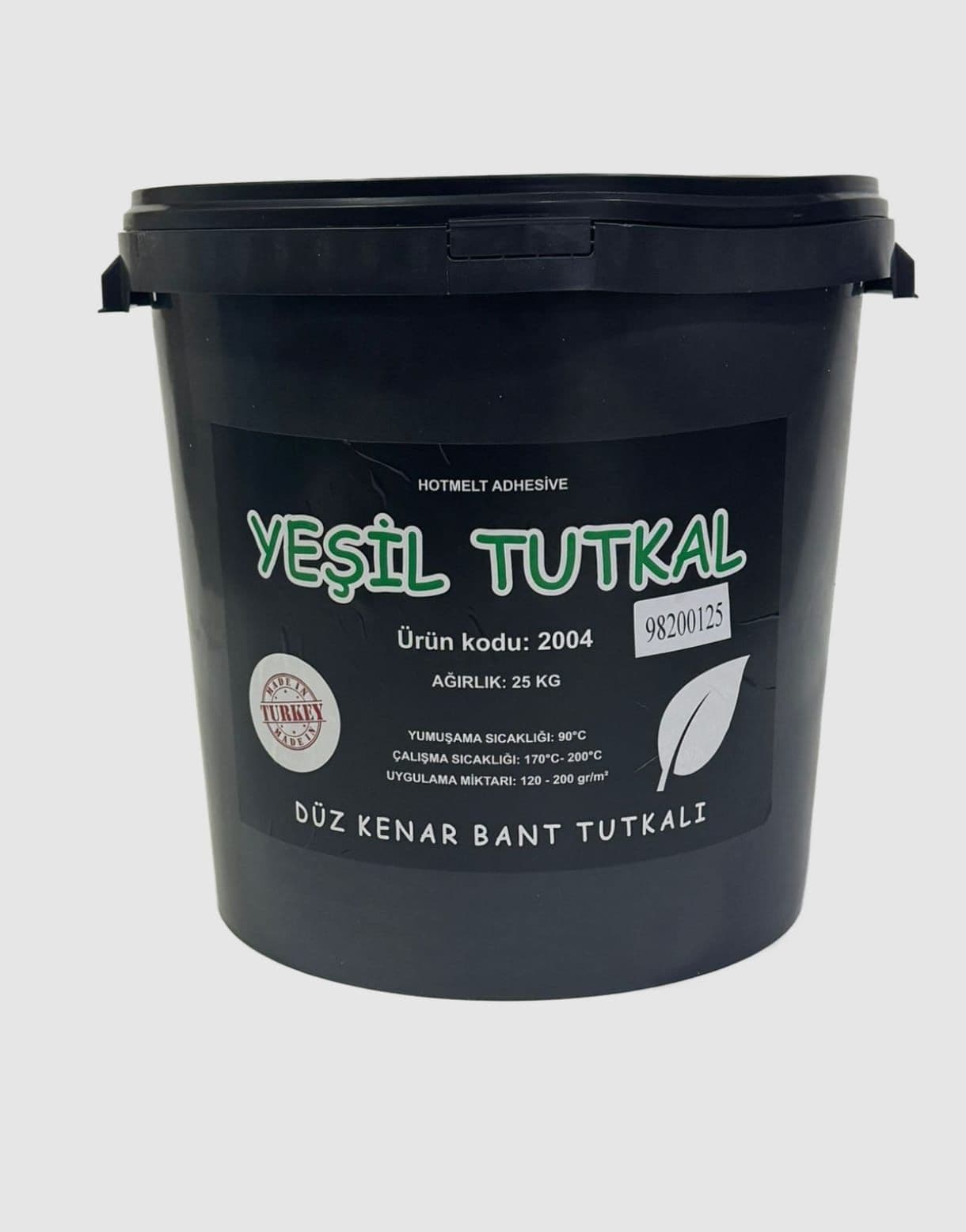
For machines that work in a straight line the catalogue has two products. The first is a granular glue for straight edges, listed in the catalogue under the name 'Yeşil Tutkal'. It is sold in a 25 kg bag and in a 25 kg bucket and is meant for edging laminated chipboard and MDF. The second is an EVA granular glue in a 25 kg bucket; according to its description it is intended for automatic and semi-automatic edge banders and is used with PVC, ABS, melamine and veneer bands.
Their working temperatures are close but not the same, so the machine temperature has to be reset when you switch from one to the other. The colour of the glue (white, natural, transparent) and whether it is a filled or unfilled grade affect how the joint looks: on a dark board white glue shows as a thin line. Ask about the colour and grade of the batch in stock before ordering.
Glue for curved (radius) edges
A round table top, a radius corner or a shaped part will not go through a straight-line machine; they are edged on a curved-edge bander or with a hand-held unit. The work goes differently here: the part is turned by hand, the speed is low and uneven, and the band, bent round the radius, tries to spring back straight.
The EVA glue for curved edges is made for these conditions. According to the product data its working temperature is 120–160 °C, considerably lower than the glues for straight edges. The formulation is more elastic and has strong initial tack: it withstands the spring-back tension of the bent band, and the edge does not lift on the radius. It is sold in 20 kg packs.
In curved work the overhang and the ends of the band are mostly trimmed by hand. That calls for a sharp utility knife: a blunt blade tears the band and pulls off the freshly bonded edge.
Why working temperature matters
Every glue has its own temperature range, and the machine must be set to it. According to the product data, the granular glue for straight edges works at 170–200 °C and softens at about 90 °C; the EVA granular glue in the bucket has a range of 180–210 °C, and the one for curved edges 120–160 °C.
When the temperature is too low the melt stays thick, does not enter the pores of the board and transfers poorly to the band: at first glance the band holds, but after a while it lifts at the edge. When it is too high the glue starts to burn: it smokes, yellows, leaves black residue in the pot and loses bond strength.
The figure to go by is the one on the packaging. Bear in mind that the machine shows the temperature of the pot, and at the roller it can be lower. The softening temperature means that an EVA joint softens under strong heat; for furniture that will stand in a very hot place, choose the glue after asking the seller.
Consumption: how many metres 25 kg will cover
The stated consumption of the granular glue for straight edges is 120–200 grams per square metre. Converting that to running metres is simple. One metre of 22 mm wide band is 0.022 m²; multiplied by the consumption, that gives about 2.6–4.4 grams of glue per metre. So 25 kg in theory covers roughly 5,700–9,500 metres of edge.
This is an approximate calculation we made from the figure in the catalogue, not a manufacturer's promise. We took the full width of the band; in practice the glue is applied to the 16–18 mm edge of the board, which lowers consumption a little. On the other hand, real consumption is always higher: porous chipboard absorbs more glue, some is lost at every start-up, and the residue is thrown away when the pot is cleaned.
The practical conclusion: plan with the lower end of the range. To know the figure for your own workshop, note once how many metres one bucket lasted and calculate the next order from that.
Common defects and their causes
If the band lifts at the edge, the cause is almost always heat: the pot temperature is too low, the board or the workshop is cold, or the feed speed is too slow and the glue skins over before the band is pressed on. In winter, let boards brought in from a cold store stand in the workshop first and warm up.
If the glue line is open or thick, too much glue is being applied or the pressure of the pressure rollers is too low. The same happens when dust is left on the edge: the glue sticks to the dust, not to the board. So clean the edge after cutting and keep the dust extraction working.
If glue squeezes out from under the band and smears the face, reduce the amount and check the temperature: an overheated melt is too runny. Yellowing and dark streaks come from burnt glue: either the temperature is too high, or the melt has stood in the pot for hours, or the pot has not been cleaned and old residue is mixing into the fresh melt.
Storage and packaging: bag or bucket
Granular glue must be stored in a dry, cool and closed place. Dust, chips and moisture get into a container left open; the dust burns in the pot and shows up as black specks in the glue line. Do not keep the container in the sun or next to a heat source: the granules stick together into a lump and no longer pour evenly into the pot.
The difference between a bag and a bucket is in handling. A bucket has a lid: you take what you need and close it again, it does not tip over, and once empty it is useful around the workshop. A bag takes up less room in the store, but after opening it has to be tied tightly or the remainder poured into a container with a lid.
The pot needs the same care. Do not keep edge banding hot-melt glue hot for hours with no work going through: lower the temperature during breaks, top up the pot a little at a time and clean it regularly. Edge bands and other workshop materials can be found in the catalogue.
For an overview of every type, see the furniture hardware guide.
Want to place an order?
You can easily place your orders via WhatsApp.