

 Fasteners & Materials
Furniture Screw Sizes: Which Screw for Which Job
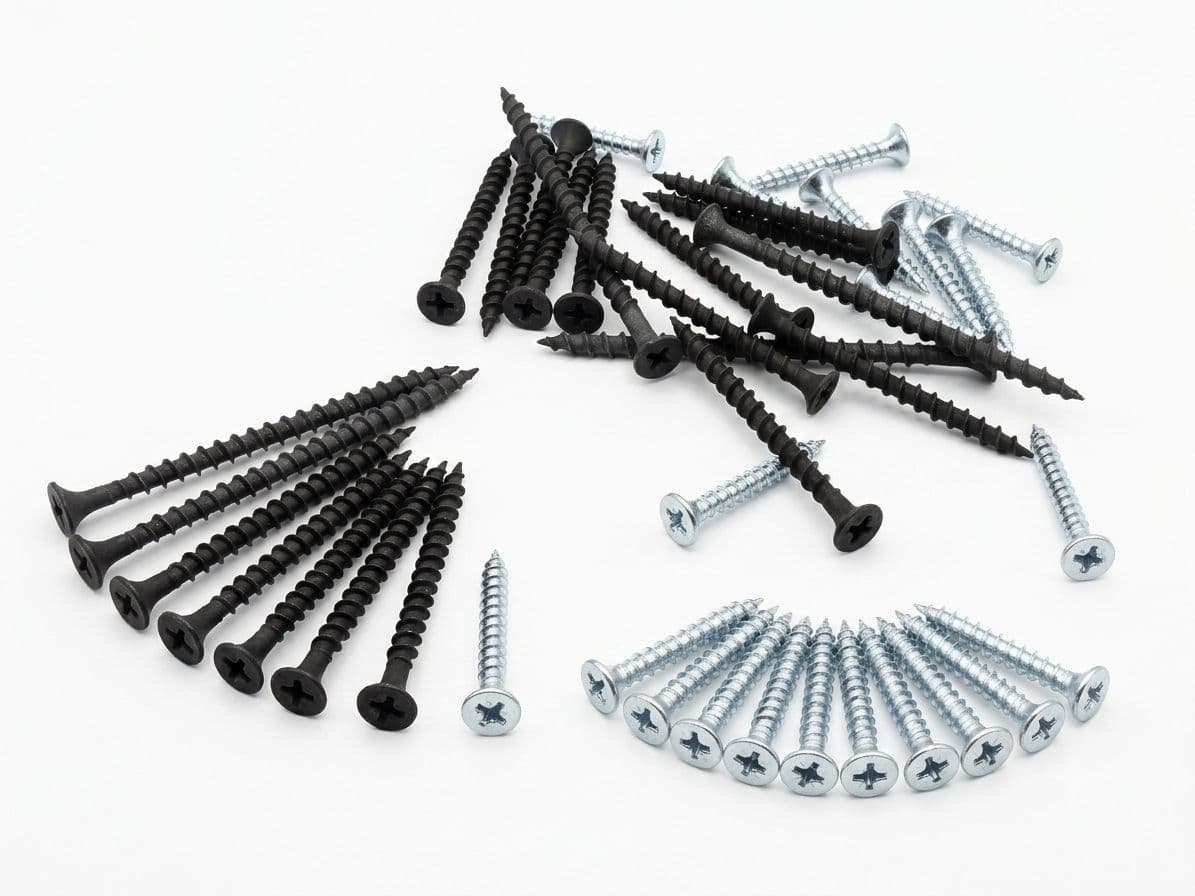
Furniture screw sizes are two numbers: in 3.5×16 the first is the diameter, the second the length in mm. Short screws fix hardware, long ones join panels. Below we go through which job each size from 3.5×16 to 6×80 suits, why a pilot hole is drilled in a chipboard edge, where nails, F brads and headless pins belong on back panels and mouldings, and when a T-nut or rivet nut with a bolt should replace a screw.
How to read a screw size: what 3.5×16 means
On the box and in the catalogue, furniture screw sizes are written as 3.5×16 or 3.5/16. The first number is the outside diameter of the thread, the second is the length of the screw, both in millimetres. So 4.2×65 is a screw 4.2 mm in diameter and 65 mm long. The diameter decides how much load the screw takes and which hardware hole it seats in; the length decides how deep it goes into the material.
The names vary but the fastener is the same: screw, wood screw, şurup, vida, vint, or samorez in Russian — in the trade these all mean one thing. We stock furniture screws in eight sizes from 3.5×16 to 4.2×75. To pick a size, answer two questions: what is the screw fixing, and how thick is the material it goes into. The sections below follow those two questions.
Short screws for hardware: 3.5×16 and 3.5×18
A hinge mounting plate, a drawer slide, a bracket or a leg flange is screwed onto the face of the board, so the main rule is this: the screw must be shorter than the board is thick, otherwise the point comes out of the other face or raises a bump in the laminate. In 16 mm board use 3.5×16: part of the length stays in the metal of the hardware, so less than 16 mm goes into the board. In 18 mm board 3.5×18 is chosen by the same reasoning.
Both sizes are in both of our screw listings. Turn the torque of the driver down when tightening: an over-driven screw strips its hole in chipboard and will not hold again. A stripped hole will take a screw one size thicker, but under load-bearing hardware such as a hinge it is better to repair the hole: glue in a sliver of wood or a dowel and drive the screw again. Fitting the hinge itself is a separate subject: how to install and adjust cabinet hinges.
Mid sizes for joining panels
When two boards are joined face to face, the screw must be shorter than their combined thickness: 3.5×25 suits two 16 mm boards, 3.5×32 two 18 mm boards. When a panel is fixed into the edge of another, a different rule of thumb applies: roughly two thirds of the screw's length should go into the second piece. A 3.5×50 screw passing through a 16 mm side panel puts 34 mm into the edge of the shelf or bottom, which is that proportion. 4.2×50, 4.2×65 and 4.2×75 are for thicker parts, battens and framing.
The edge is the weakest part of chipboard: a screw driven without drilling splits the board into layers, especially near a corner. So before screwing into an edge, drill a pilot hole about the diameter of the screw's core without the thread, and give the first piece a clearance hole the screw passes through freely, so that the two parts are pulled tight together. Where a screw head must not show, the joint is made with a hidden connector, not a screw; see how to fit minifix cam connectors.
Thick screws: 5×50–70 and 6×70–80
Screws 5 and 6 mm in diameter — 5×50, 5×60, 5×70, 6×70 and 6×80 — are not for furniture board but for framing: bed and table frames, timber battens, sofa frames, fixing furniture to a wall. Do not drive one into the edge of 16–18 mm board: its diameter takes up about a third of the board's thickness and the material splits.
In timber a pilot hole is essential for these screws, or the batten splits along the grain. For wall fixing the screw works together with a plug: the plug's diameter and length are matched to the screw, and its type to the wall material — concrete, brick or hollow block. When working out the length, subtract the thickness of the part being fixed: the load is carried by the part of the screw that sits in the wall. Never hang a wall cabinet on a screw that passes only through the hardboard back; it must go through a solid part of the carcass or through a hanging bracket.
Back panels and mouldings: nails, F brads and headless pins
The back panel of a cabinet (hardboard, HDF) is nailed to the carcass, not screwed. For a maker working with a hammer, thin 25 mm nails are enough. Measure the diagonals of the carcass before nailing: the back panel holds the carcass square, and if it is nailed on out of square the doors will not hang straight.
Those working with an air nailer take F-type brad nails: 15, 20, 25, 30 and 50 mm. As a rule of thumb the brad should be two to three times as long as the piece being fixed is thick: 15F–20F for a thin back panel, 25F–30F for mouldings and thick beading, 50F for battens and frame parts. On decorative trim where no mark may show on the face, use headless pins in 15, 20 and 25 mm; the box reads 615, 620, 625, and the last two digits are the length. With no head, a pin holds weakly on its own: its job is to keep the piece in place while the glue sets. Sizes of the U staples used for upholstery are in upholstery materials.
When a screw will not hold: T-nuts and rivet nuts
In chipboard and timber a screw hole loosens a little every time the joint is taken apart. In a joint that is undone often or carries a heavy load — a table or sofa leg, a bed corner, a knock-down frame — a metal thread is set into the material and a bolt replaces the screw. For timber and board this is the T-nut, in M6 and M8. The nut is hammered into the hole from the side opposite to where the bolt enters; its prongs bite into the wood, and the tighter the bolt is drawn, the more firmly the nut seats. Fitted the wrong way round, the load pushes it out of its hole.
Thin-walled metal tube and profile cannot be tapped. Here a rivet nut is used, also in M6 and M8: it goes into a hole matching its body and is compressed with a setting tool, so that it expands behind the metal and forms a threaded seat that does not turn. On tables and frames with metal legs the part is bolted to that seat.
Summary: choosing the size by job
Hinges, slides, brackets and legs: 3.5×16 into 16 mm board, 3.5×18 into 18 mm board. Two boards face to face: 3.5×25 (16+16) or 3.5×32 (18+18). Panel into an edge: 3.5×50 or 4.2×50 with a pilot hole. Thick parts, battens and framing: 4.2×65 and 4.2×75. Timber, bed and table frames, wall fixing: 5×50–70 and 6×70–80, with a plug in the wall. Back panel: nails or 15F–20F. Mouldings: 25F–30F, and headless pins with glue where no mark is acceptable. Knock-down joints: a T-nut in timber, a rivet nut in metal tube, and a bolt.
When ordering, check how many pieces are in a pack and which driver bit the head takes. Counting screws is easy once the hardware is known: count the holes in every hinge, slide and bracket. The hardware itself can be listed from the kitchen cabinet hardware checklist. All fasteners are shown with their sizes in the catalogue.
For an overview of every type, see the furniture hardware guide.
Want to place an order?
You can easily place your orders via WhatsApp.