

 Kitchen & Wardrobe
Wardrobe Interior Fittings: Rails, Pull-Out Hangers
Wardrobe interior fittings come down to a hanging rail with its holders, a pull-out hanger for a shallow cabinet, shelf supports and rollers for sliding doors. Which of them you need is decided by the depth of the cabinet and what you will keep in it. This article explains how to divide a wardrobe between hanging and folded clothes, how oval and round rails differ, and how to choose rail holders, a pull-out hanger and shelf supports. At the end we draw up a sample list for one wardrobe.
Planning the wardrobe: what hangs and what is folded
The list of fittings follows from the plan, so first split the clothes into two groups: those that hang and those that are folded. Hanging clothes are also of two kinds. For shirts, jackets and short coats a short hanging section is enough, and room is left under it for a drawer or a shelf. Overcoats, raincoats and long dresses need a full-height section.
Folded clothes go on a shelf or in a drawer. A shelf is cheap and its height can be changed; a drawer is convenient for small items but needs slides. For how to choose them, see drawer slide types.
Once the sections are drawn, the wardrobe interior fittings are easy to count: one rail and two holders for each hanging section, four shelf supports for each loose shelf, a pair of slides for each drawer. The inside depth of the cabinet then decides whether a rail or a pull-out hanger goes in.
Hanging rail: oval and round, in 3 metre bars
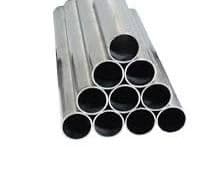
A hanging rail (wardrobe tube) is sold as a 3 metre bar and cut on site to the inside width of the section. One bar often gives rails for several sections, so first add up the widths of all the hanging sections and then work out how many bars you need. Before cutting, check how far the holder takes the rail in: put the holders in place, measure the distance between them and cut the rail to that.
There are two shapes. The oval hanging rail is fitted on edge: with its tall side vertical it resists sagging under load better, and it does not turn in the holder. The round hanging rail is the classic version and its holder is simple.
Each shape has three variants in the catalogue. Ask when buying what the difference between them is, whether colour, finish or wall thickness: a thicker-walled rail is the better choice for a section that will carry heavy coats.
Rail holders and the centre support
The rail is fixed to the side panels with holders, two for each rail. The holder has to match the shape of the rail: the holder for round rail has a round socket and the holder for oval rail an oval one. One will not do the job of the other. Both are listed in the catalogue with the size 25 mm; buy the rail and the holder together and check how they fit one into the other, because a rail that sits loose works its way out of the socket over time.
When you fix the holder to the side panel, choose the screw length by the thickness of the board so that the tip does not come through the other face. Both holders must be at the same height and the same distance from the front edge: fix one first, insert the rail and mark the position of the other with a spirit level.
A long rail sags in the middle under load. Fit a centre support to a rail longer than about one metre, or divide the section in two with a partition: two short rails hold better than one long one.
Pull-out hanger for a shallow cabinet
Clothes on hangers hang across the cabinet on a rail, and that needs roughly 55–60 cm of inside depth. When a hallway cupboard or a cabinet in a narrow room is shallower than that, an ordinary rail does not work: the door presses on the shoulders of the clothes and will not close. A pull-out hanger is fitted in such a place. It is fixed to the top panel of the cabinet or under the top shelf, and the clothes hang facing forward, that is, lined up along the depth. The hanger slides forward on its runner and you take the item you need.
There are two kinds in the catalogue, each in lengths of 300, 350 and 400 mm. The Winchester pull-out hanger is the standard version, and the PRO pull-out hanger is offered as the reinforced one; to see the difference, take both in your hands and pull them out. Choose a length shorter than the inside depth of the cabinet so that it fits behind the closed door.
The board it is fixed to must be sound: the weight of all the clothes rests on a few screws, and the load on them is greater when the hanger is pulled out.
Shelf supports and glass shelves
A loose shelf rests on shelf supports pushed into holes in the side panels, four for each shelf: two in the left panel and two in the right. All four must be at the same height or the shelf will rock; mark out the holes with a template. If you drill several rows of holes, the shelf height can be changed later. Choose the hole diameter by the pin of the support and limit the depth so that you do not drill through the side panel.
A wooden shelf stays in place under its own weight. A glass shelf slides on smooth metal, so a shelf support with a suction cup is used for it: its pin goes into the side panel, and the soft suction cup on top grips the glass, holds it and keeps it from touching the metal.
A wide shelf bends in the middle under load. Do not make a shelf for books or thick folded clothes too wide, or put a partition under it.
Sliding-door rollers, locks and other parts
In a sliding-door wardrobe the door does not swing on hinges but slides sideways along a profile. That movement is provided by the sliding-door roller: it is fixed to the door frame and runs on the track. The roller is a part that wears over time; when the door moves heavily, makes a noise or comes off the track, it is the first place to look. When buying a replacement, bring the old roller with you and compare, because systems differ and not every roller fits every profile.
In a wardrobe with hinged doors the hinge does this job; the types are described in cabinet hinge types.
A furniture lock is fitted to a section where documents or valuables are kept: when the key is turned, the bolt catches behind the carcass and the door will not open. In the hallway part and in an open section, coat hooks are used: for an everyday jacket and a bag they are more convenient than a rail. Note each of these separately in the plan so that it is not forgotten in the order. If the wardrobe is to be lit, choosing the strip and door sensor is covered in furniture LED lighting.
A sample list for one wardrobe
As an example, take a wardrobe 1800 mm wide and 600 mm deep, built from 18 mm board, with three sections. The two sides and two partitions together take up 72 mm, which leaves each section 576 mm wide inside. Two sections are for hanging and one for shelves.
The hanging sections need two rails, each a little shorter than 576 mm; both come out of one 3 metre bar. There are four holders, and no centre support is needed because the sections are shorter than a metre. In the shelf section four loose shelves make 16 shelf supports; if the two shelves above the rails also rest on supports, the total is 24.
If the depth were 450 mm instead of 600, a 400 mm pull-out hanger would go into each hanging section in place of the rails. This is only an example; count for your own dimensions by the same rule. How the carcass itself is put together is covered in the article on minifix connectors, and all the parts are in the catalogue.
For an overview of every type, see the furniture hardware guide.
Want to place an order?
You can easily place your orders via WhatsApp.