

Extending Table Mechanisms: Types and Selection
An extending table mechanism is one of four kinds: synchronised slides, a centre-leaf mechanism, a wall-folding bracket or a lifting transformer. The choice follows the room and how often the table is opened. With synchronised slides the leaf is stored separately, with a centre-leaf mechanism it stays inside the table, a bracket folds the table against the wall, and a transformer raises a coffee table to dining height. Below we explain how each works, the sizes in the catalogue, and the rollers, alignment pins and legs needed alongside.
How a table gets bigger: four basic schemes
In the first scheme the top is made of two halves: they move apart on slides and a separately stored leaf is laid in the gap. The second scheme opens the same way, but the leaf is kept inside the table, under the top, and comes up from there into place when the table is opened.
In the third scheme the table does not get longer, it stows away: the top rests horizontally on brackets fixed to the wall and drops down along the wall when it is not needed. The fourth scheme is the transformer: the top of a low coffee table rises on a mechanism and the table reaches dining height.
These four do not replace one another. The first two are for a full-size dining table, the third for a kitchen or balcony with no room for a permanent table, the fourth for a living room that has no separate dining table. An extending table mechanism is chosen before the table is drawn, because the frame dimensions are fitted to it.
Synchronised table slides: 600–1200 mm
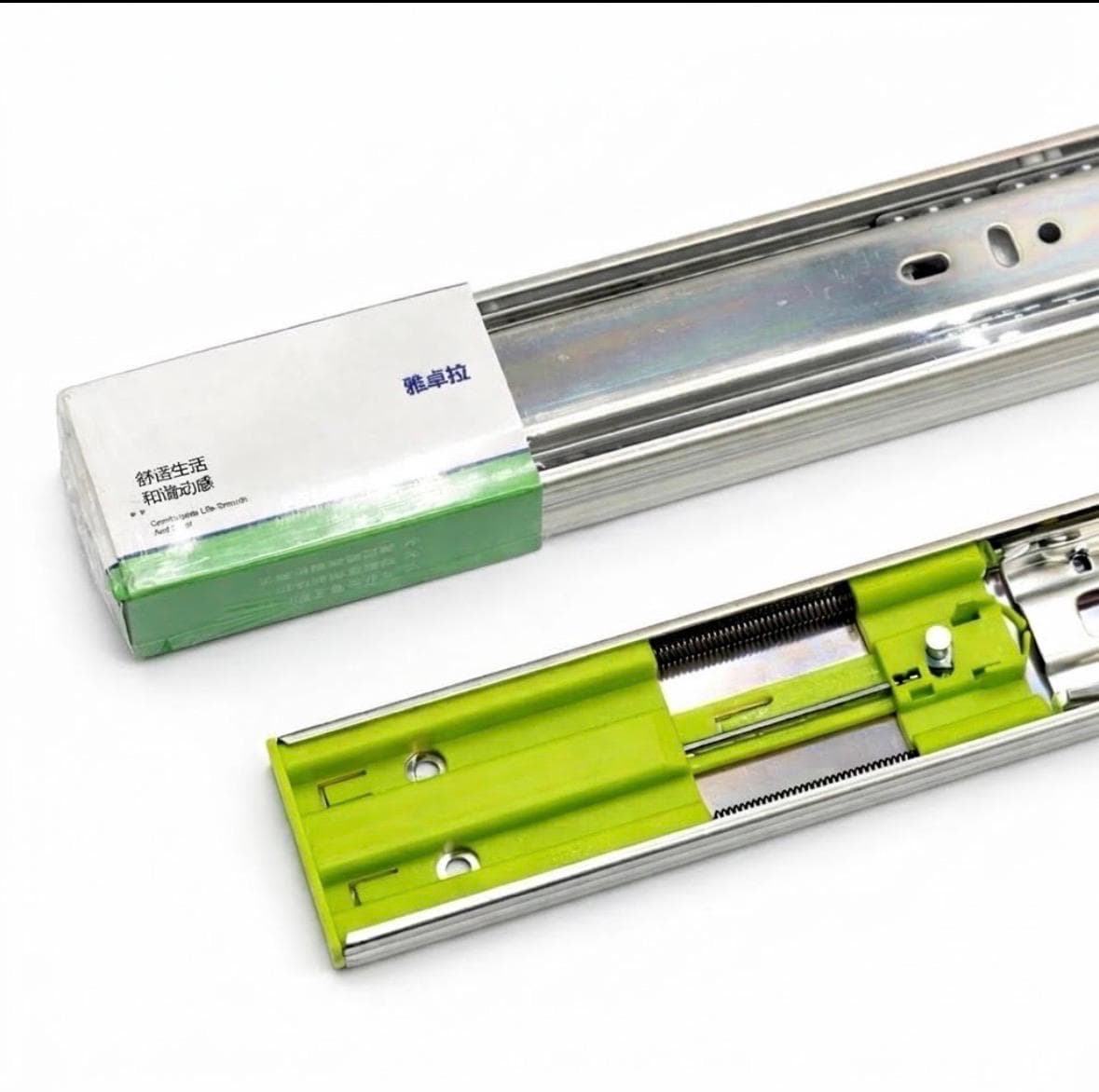
Synchronised table slides work as a pair: they are linked so that when one half of the top is pulled, the other half travels the same distance the opposite way. One person opens the table, the gap stays exactly in the middle, and the leaf is laid into it. The leaf is stored separately — in a cupboard, behind the sofa, or on a shelf built under the top.
The catalogue has four lengths: 600, 800, 1000 and 1200 mm. The slide has to fit inside the table's frame (the aprons) and its travel has to cover the width of the leaf; check before ordering which length suits which table and how many slides are in a set. The key condition when fitting is that the slides are exactly parallel to each other, otherwise the table opens halfway and jams. Mark them out in the closed position, hold them with one or two screws, open and close the table to check, and only then drive the remaining screws.
Centre-opening and double-centre-leaf mechanisms
The centre-opening table mechanism keeps the leaf inside the table. The halves of the top are drawn outwards, and the centre leaf hidden beneath rises and settles into the gap. The leaf does not have to be fetched and carried, does not get lost and is not scratched in handling — for a table that is opened often this is the main advantage.
The double-centre-leaf mechanism does the same job with two panels: the centre section is made of two leaves, stored folded inside and laid side by side when the table opens. The catalogue lists it in 900 and 980 mm. With both mechanisms the table design follows the mechanism: the inside dimension of the frame has to match it, and the apron has to be deep enough to hide the leaf stored inside. The leaf is cut from the same board and thickness as the top and edged with the same PVC edge banding, so that the opened table reads as one surface.
Wall-folding table mechanism
The folding table mechanism is a hinged bracket: opened, it holds the top horizontal; folded, the top hangs down parallel to the wall and takes up almost no room. It is used for a breakfast table in a small kitchen, a work surface on a balcony, an extra surface in a workshop. One top normally takes two brackets.
In a table like this the load ends up on the wall fixings. Do not fix the bracket to plaster: fix it to a solid wall, or to a sound board fastened to the wall with plugs, with the plug chosen to suit the wall material. Screws and plugs are covered in furniture screw sizes. Take the depth of the top from the arm of the bracket: if the top projects far beyond the arm, leaning on its edge sharply increases the load on the fixings. Ask about the mechanism's load limit before ordering.
Transformer mechanism: from coffee table to dining table
The transformer table mechanism is a lifting metal frame fitted between the body of a coffee table and its top. Folded, the table is low; when the top is lifted, the mechanism opens and holds the top at dining or working height. It is meant for a living room or studio flat that has no separate dining table.
The catalogue has two versions: plain and “vakuumlu”. In local trade usage “vakuumlu” normally means a damped, soft action, but ask before ordering exactly how the two versions of this mechanism differ. Watch three things in the design. The base has to be heavy and wide: lean on the raised top and a light base can tip over. The size and weight of the top must be chosen to suit the mechanism. The fixing points carry the whole load, so short screws into thin board are not enough: thicken the board or fasten the mechanism with bolts and nuts.
Supporting parts: roller, alignment pins, corner bracket, leg
The more precisely the panels of an extending table meet, the neater it looks. That is the job of the table alignment pin and socket set: a projecting pin goes into the edge of one panel and a socket into the edge of the panel facing it; on closing, the pin enters the socket, the panels sit at one level and cannot shift sideways. Sets go both between the two halves and on both edges of the leaf. The table roller lets a moving panel travel without rubbing or catching.
The frame is assembled at the corners with metal corner brackets; on a table with wooden legs the bracket also pulls the leg tight to the aprons and makes the table knock-down. The 710 mm table leg together with the top gives about 73–75 cm, the usual dining table height. Legs, castors and the felt pads that protect the floor are covered in detail in furniture legs and castors.
Choosing: room size and how often it is used
If the table is opened a few times a year, when guests come, synchronised slides are enough: the construction is simple, and the only thing to find is somewhere to keep the leaf. If it is opened every week or every day, a centre-opening mechanism is more convenient, because the leaf is always inside the table. If the extra surface should be made up of two leaves, look at the double-centre-leaf mechanism. Ask the seller how much each mechanism lengthens the table.
If the room has no space for a permanent table, there are two options. In a kitchen or on a balcony where the wall is free and the floor is tight: a folding bracket. In a living room that already has a coffee table and needs a dining table only now and then: a transformer. In cost terms, synchronised slides and the folding bracket are the simple solutions, while the leaf mechanisms and the transformer are more expensive sets. Buy the mechanism before drawing the table, or keep its dimensions to hand: the frame is cut to suit it. All table mechanisms are in the catalogue.
For an overview of every type, see the furniture hardware guide.
Want to place an order?
You can easily place your orders via WhatsApp.