

 Handles, Legs & Lighting
Furniture Legs and Castors: How to Choose
Furniture legs and castors lift a cabinet off the floor and level it: adjustable plastic legs in kitchens, chrome legs 50–200 mm, castors if it must move. This article covers where each is used, how the kitchen leg height sets the plinth height, the 710 mm table leg, the flat support and the felt pads that protect parquet, and finally how many legs one cabinet needs.
Why furniture is not set straight on the floor
A floor is rarely flat: a difference of a few millimetres over a metre is normal. When a carcass stands directly on the floor it takes on that unevenness: the sides go out of square, the gaps between doors become uneven, drawers roll open by themselves. An adjustable furniture leg lets each corner be raised or lowered separately, the carcass comes level, and the adjustment range of the hinges is left for the door itself and not used up on the floor's fault.
The second reason is water. In a kitchen, spilled water and a wet cloth reach the exposed bottom edge of the chipboard, the board swells and does not recover. A leg lifts the board clear of the floor, air moves underneath and the floor can be mopped. Under furniture on visible legs there is also room to sweep or to let a robot vacuum pass.
Adjustable plastic legs for kitchens and cabinets
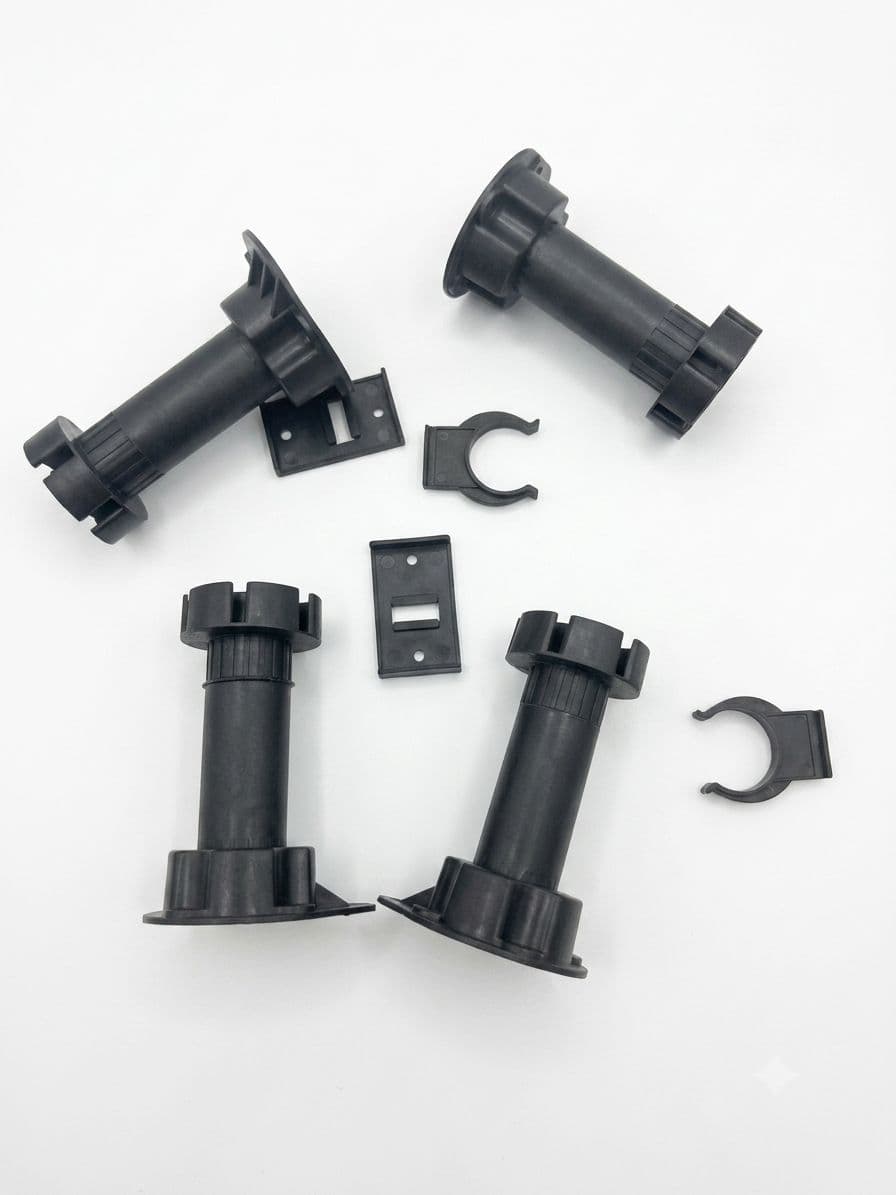
Base kitchen cabinets stand on adjustable plastic legs, often simply called kitchen legs. The leg is screwed to the cabinet bottom through its flange, and its body is threaded: turning it makes it longer or shorter. Plastic is not harmed by water, and the legs are hidden from the front by the plinth. The adjustment range depends on the model; check it on the leg itself.
We stock heights of 100 and 120 mm. The leg height sets the plinth height, and the worktop height is the sum of leg, carcass and worktop: a 120 mm leg in place of a 100 mm one raises the worktop by 2 cm. Ask when ordering whether the clip that fastens the plinth to the leg is included. The rest of the kitchen fittings can be counted from the kitchen cabinet hardware checklist.
Chrome metal legs: 50–200 mm
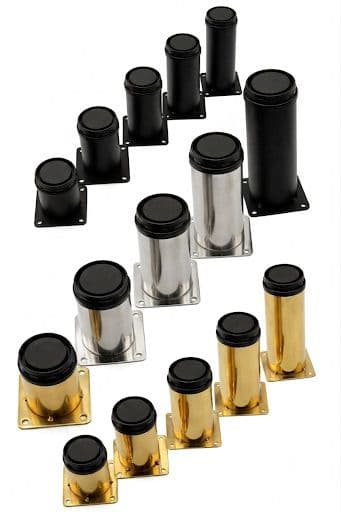
Where the leg will be seen, choose a chrome metal leg. There are six heights: 50, 80, 100, 120, 150 and 200 mm. This leg adjusts too: the black plastic foot at the bottom turns and levels the furniture. It is used under TV units, chests of drawers, wardrobes and desk pedestals, and under kitchens built without a plinth.
Choose the height on two grounds. The first is looks: on 50–80 mm legs furniture sits close to the floor and reads as heavy and stable, on 150–200 mm it looks light, as if floating. The second is cleaning: if a mop or a robot vacuum has to pass underneath, measure the height of the appliance and add a margin. A tall leg is more sensitive to sideways load, so short legs suit a heavy, tall wardrobe and tall legs suit light, low furniture. Note: if a kitchen needs a 150 mm leg, it exists only in the chrome range; the plastic legs are 100 and 120 mm.
Castors: 40 and 50 mm, braked and plain
Furniture that gets moved — a coffee table, a pedestal, a toy box, an under-bed drawer, a serving trolley — is fitted with castors in place of legs. A castor is screwed to the underside of the furniture through its rectangular metal plate and swivels about its own axis. The diameters are 40 and 50 mm. A bigger wheel crosses tile joints, thresholds and the edge of a rug more easily; a smaller wheel keeps the furniture lower. Bear in mind that the overall height of a castor with its plate is greater than the wheel diameter.
Furniture that has to stay where it is put gets a braked furniture castor: press the pedal and the wheel locks. Not all four need a brake — usually the two on the side within reach are braked and the other two are plain. The catalogue also has a second castor listing in 40 and 50 mm; check before ordering whether it has a brake, and how much load one castor carries if the furniture is heavy.
The 710 mm table leg and the flat support
The 710 mm table leg is for dining tables and desks: together with the thickness of the top it gives a table about 73–75 cm high, the usual height for a table you sit at. As a rule the leg is fixed through its flange to the underside of the top. The screw length is decisive here: it must be shorter than the top is thick, or the point comes through the face of the table. Size selection is covered in furniture screw sizes. On an extending table the position of the legs depends on the mechanism; see extending table mechanisms.
The flat support is for low furniture: a coffee table, a TV unit, a pedestal built without a plinth. It lifts the furniture only slightly off the floor: a thin shadow line is left underneath and the bottom edge of the board does not touch the floor. Check its height and colour on the product page.
Felt pads: protection for parquet and laminate
Self-adhesive furniture felt pads are stuck under the legs of chairs, tables, armchairs and sofas so that the furniture does not scratch parquet, laminate or tiles when it is moved, and makes less noise. There are two shapes: round in 20 and 25 mm, square in 20×20 and 25×25 mm. Shape and size are chosen to suit the foot of the leg: the pad must not be larger than the foot, because an overhanging edge folds over and the pad soon comes off.
Before sticking, clean dust and grease off the underside of the leg, apply the pad to a dry surface and press it down hard. Remove what is left of the old pad completely: a new pad does not hold on old adhesive. Felt wears fastest on chairs, because they are dragged dozens of times a day. Check from time to time: a pad that is compressed thin or has picked up grit starts scratching the floor itself and should be replaced. Furniture on castors needs no felt.
How many legs are needed and where they go
Common practice is four legs to a cabinet, one in each corner. That is a starting point, not a norm: extra legs go under a wide cabinet, under a heavily loaded section (crockery, a sink, a stone worktop) and under an internal partition, because the partition passes its load to the bottom panel, and an unsupported bottom sags with time. Put the legs as close to the side panels as you can, so that the load runs from the side straight into the leg and not into the middle of the bottom.
In a kitchen with a plinth the front legs are set back from the front edge of the cabinet — by the thickness of the plinth plus the distance the plinth is recessed behind the doors. When installing, start with the cabinet at the highest point of the floor: level it, then bring the others up to it — a leg can always be extended, but not lowered below its minimum. All sizes of legs, castors and felt pads are in the catalogue.
For an overview of every type, see the furniture hardware guide.
Want to place an order?
You can easily place your orders via WhatsApp.