

 Fasteners & Materials
Upholstery Materials: What You Need to Repair a Sofa
Upholstery materials besides fabric: the seat base (zigzag spring or elastic webbing), fibre filling, staples, tufting buttons and the sofa mechanism. This article is for workshops that build sofas and for upholsterers who repair and re-cover old ones: it explains what each material does, how a staple size is read and which buttons and mechanisms exist, and ends with a sample list for a three-seat sofa.
The seat base: zigzag spring or elastic webbing
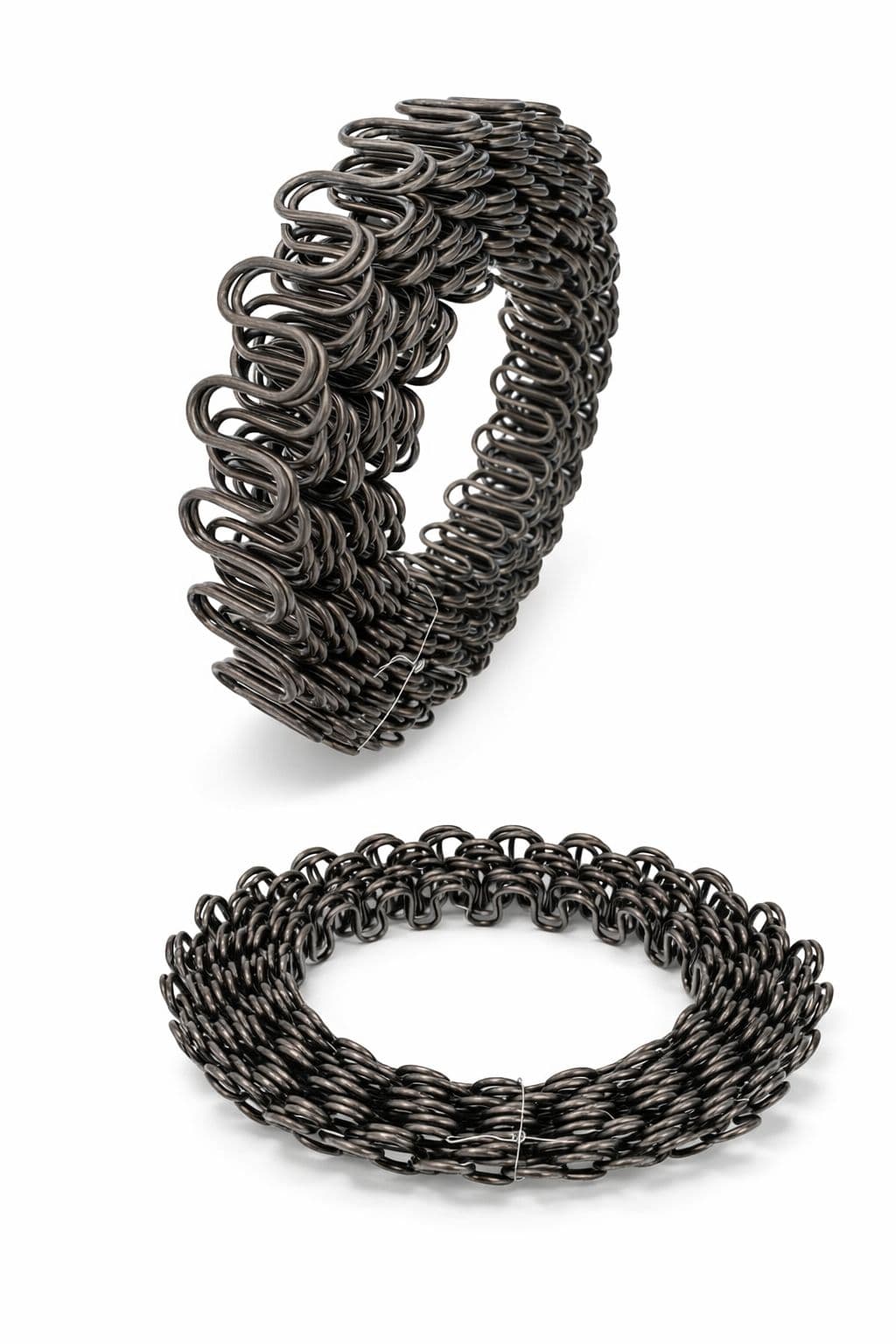
Under the foam there has to be a springy base that carries it, otherwise the seat soon sags. The first method is the zigzag spring (sinuous spring): a steel wire spring is stretched between the front and back rails of the frame, fixed at its ends with special clips, and the rows are tied to one another so that the whole surface works together. The spring gives a firm, resilient support and needs a strong frame, because it constantly pulls the rails inwards.
The second method is elastic webbing; upholsterers also call it sofa rubber or “simiteks”. The webbing is stapled to the frame under tension, with the lengthwise and crosswise strips woven over and under each other. Webbing gives a softer sit, takes up little space and suits a light frame, so it is most often used in backs, thin seats and armchairs. One sofa can have both: springs in the seat, webbing in the back. A dense cloth is stretched over the springs first and the foam is laid on top of that, otherwise the springs cut into the foam. Check the length and width of the roll when ordering.
Filling: what fibre is used for
Furniture fibre is siliconised polyester fibre, sold in 10 kg packs. Its job is to give softness and volume: back cushions, scatter cushions, the top layer of armrests, a soft layer over the seat foam. Siliconised fibre opens up again after being compressed and clumps little, so a cushion keeps its shape.
Fibre does not replace foam. In a seat the foam carries the load and the fibre only adds softness on top; a seat filled with fibre alone packs down flat. When filling a cushion, put the fibre into an inner case and not straight into the cover fabric, and in a wide cushion divide the case into compartments with stitching, otherwise the filling migrates to one corner. An inner case also lets the cover be taken off for washing. How much fibre one cushion takes depends on its size and the firmness wanted: fill one first, weigh it, and work out the rest from that.
Upholstery staples: 80/06 to 80/16
Fabric, lining and webbing are fixed to the frame with U-type staples. The size is written as two numbers: in 80/10, 80 is the staple series and 10 is the leg length in millimetres. A series 80 staple has a crown of about 12.8 mm and is made for a pneumatic upholstery stapler that takes this series; an ordinary hand tacker will not drive it. Before buying, read the series and the maximum leg length marked on the stapler.
There are six lengths: 80/06, 80/08, 80/10, 80/12, 80/14 and 80/16. A short leg (6–8 mm) is for thin fabric and lining on hardwood: a long staple does not go fully into hardwood and buckles. 10–12 mm is used where the cover fabric lies in several layers, and in softwood. 14–16 mm is for elastic webbing, thick build-ups and places under tension; a short staple there works loose with time.
Tufting buttons: nail-back and hook-back shells
In tufted (capitonné, Chesterfield) work the fabric is drawn in by a button made from a metal shell: on a press the shell is covered with the same fabric or leather as the furniture. The die of the press has to match the diameter of the shell, so choose the size — 32 or 36 mm — to suit the die you have. If the fabric is thick, press one or two trial buttons first.
There are two types by fixing method. The nail-back shell has a pin at the back: it passes through the foam and is driven into the rigid base behind it — plywood or board. It is used where there is a solid backing, such as a headboard or a wall panel. The hook-back shell has a hook at the back: twine or wire is tied to it, passed through the foam and fastened under tension behind the frame. This type suits deep tufting and a sofa back built on webbing, because the depth of the pull is set by the length of the twine. Check on the product page how many pieces are in a pack.
Sofa mechanisms: zero-wall and backrest mechanism
The zero-wall mechanism lets a sofa be opened without pulling it away from the wall. In an ordinary construction the back tips rearwards and needs free space behind the sofa; with this mechanism the sofa slides forward as it opens and the back does not touch the wall. The sofa stands tight against the wall, and wallpaper and plaster are not rubbed.
The backrest mechanism is a metal frame that changes the position of the back: the sofa moves on it from the sitting position to the sleeping position. Mechanisms of this kind are fitted as a pair, on the left and right of the frame; check when ordering how many pieces are in a set. For a repair, take the old mechanism off and bring it with you, or note its dimensions: the spacing of the fixing holes, the length of the arms and the thickness of the metal have to match, or the frame will need drilling again. Bolting the mechanism to the frame is more reliable than screwing it, because the load falls on those points every time the sofa is opened.
Corner sofa connector, zipper and other small parts
To stop the sections of a corner or modular sofa drifting apart, a sofa connector is fitted under the frames: one part is fixed to one module and the mating part to the other, and when the modules are pushed together the parts engage and lock. When the sofa has to be moved, nothing needs unscrewing to separate the modules.
For removable covers and cushion cases, continuous zipper is used: the chain is cut to the length needed and the sliders are fitted separately. That is easier than hunting for a ready-made zip for each cushion. In knock-down frames — legs, armrests, the corner module — a T-nut and bolt replace the screw: however many times the sofa is taken apart, the thread does not wear out. How the nut is fitted, and the F brads used for trim, are explained in furniture screw sizes. Choosing legs, castors or felt pads for under the sofa is covered in furniture legs and castors.
A sample list for repairing one sofa
This is an example that shows how to do the sums, not a ready-made norm. Suppose the seat of a three-seat sofa has 14 rows of old springs, each 60 cm long, and the back has three cushions 60 cm wide. Springs: take the number of rows and their length from the old sofa — 14 × 60 cm = 8.4 m of zigzag spring and 28 clips, one for each end of each spring. If the webbing in the back has gone slack, measure the total length of the old strips and add an allowance for stretching and stapling.
Staples: 80/08 for lining, 80/10 or 80/12 for the cover fabric, 80/14–80/16 for webbing. Filling: fibre for three back cushions; fill one, weigh it and multiply by three. Zipper: one length the width of the back edge for each cushion case, that is 3 × 60 cm = 1.8 m of continuous zipper and three sliders. If the sofa is tufted, count the buttons from the pattern and add a few spares. Replace the mechanism only if it has worked loose or bent. All of these upholstery materials are in the catalogue.
For an overview of every type, see the furniture hardware guide.
Want to place an order?
You can easily place your orders via WhatsApp.